Nickel is the metal that makes steel stainless and long-range batteries dense — and in a single decade one archipelago took it over. Indonesia now digs about two-thirds of the world's nickel and, with China's process technology and capital, refines most of it too. The price benchmark broke spectacularly in 2022, five straight years of surplus then switched off mines across Australia, New Caledonia and Canada, and since 2025 Jakarta has rationed its ore like OPEC rations crude. This site tracks where nickel is mined, smelted and consumed, how the quota machine works, and who is left standing outside it — using open data from USGS, INSG, the IEA, BGS and price agencies.
0of nickel mined worldwide in 2025 — an all-time high (USGS)
0of world mine supply came from Indonesia in 2025 (USGS / INSG)
0of the world's refined nickel was produced in Indonesia and China in 2025 (IEA)
0the price LME nickel hit on 8 March 2022 — before the exchange cancelled the trades
Interactive map
The nickel world map
Mines and smelter parks, HPAL plants, refineries, suspended operations and development projects — from the laterite terraces of Sulawesi and Halmahera to the Arctic sulphides of Norilsk and Sudbury, and the mothballed pits of Western Australia. Tap a marker for details; toggle layers below. Circle size ≈ scale of operation.
MineSmelter park / refineryDisrupted / closedDevelopment project
Why Indonesia shows refineries sitting on top of mines: the country that digs two-thirds of the world's nickel is also its No. 1 refiner — 45% of refined output in 2025 (IEA), ahead of China's 31%. Since the 2020 ore-export ban the laterite never leaves: it goes straight into RKEF furnaces and HPAL autoclaves inside the industrial parks at Morowali, Weda Bay, Obi, Konawe and Pomalaa, so the smelter-park markers there are the plants that turn ore into nickel pig iron, matte and MHP. Most of that is intermediate product that China finishes into class-1 metal and sulphate — but LME-grade cathode is now being made on Indonesian soil too.
From red earth to stainless — and to cells
One metal, two classes
Nickel trades in a ladder of forms split into two worlds: class-1 refined metal — the 99.8% cathode the LME contract actually delivers — and class-2 iron-nickel alloys that go straight into stainless steel and never touch an exchange. Indonesia's plants invented ways to jump between the two, and the market has never priced cleanly since. Tap a stage.
From a red laterite bench in Sulawesi — or a kilometre-deep sulphide stope in the Arctic — to the sink in your kitchen, the turbine blade in a jet and the cathode in a long-range EV. Two ore types, two processing worlds, one price that Indonesian policy now sets.
← swipe →
Production & reserves
Where nickel comes from
Mine production by country, 2025
Tonnes of nickel content, log scale (USGS estimates)
Source: USGS Mineral Commodity Summaries 2026. World total ~3.9 Mt of nickel content; 2025 figures are estimates. Indonesia's output has grown from ~130,000 t in 2015 to 2.6 Mt; Australia's fell 54% in 2025 alone.
Reserves by country
Million tonnes of nickel content (world total >140 million tonnes)
Source: USGS Mineral Commodity Summaries 2026. Identified land-based resources exceed 350 Mt — 54% in laterites, 35% in sulphides — and a 2022 USGS study put seabed deposits at ~4.5 billion tonnes.
The scissors: surging tonnage, sinking price
World mine production of nickel (kt of nickel content, left) vs the annual-average LME cash price ($/t, right)
Sources: BGS World Mineral Statistics (production, nickel content, 2018–2024); USGS MCS 2026 (LME cash annual averages, from 2021). Output grew ~56% between 2020 and 2023 — almost all of it Indonesian — and the price paid for it: five consecutive years of surplus took the 2025 average to ~$15,000/t, below the cost of most non-Indonesian supply.
Explore where nickel is mined vs where it is refined, country by country since 1970, on the supply-chain map.
Refining
The chokepoint moved onshore
For most minerals the ore ships out and the chokepoint is a distant refinery. Indonesia inverted that: it banned ore exports in 2020, made the smelters come to the mines, and now refines almost half the world's nickel on its own soil — in plants overwhelmingly built, owned and run by Chinese groups. The top three refining countries controlled 80% of world output in 2025, up from 66% in 2021 (IEA).
Refining geography
A one-archipelago industry, a one-customer market — and the survivors around the edge
🇮🇩The RKEF machine
More than fifty rotary-kiln electric-furnace smelters — nearly all inside Tsingshan's IMIP and IWIP parks and Harita's Obi complex, up from two smelters in 2016 — turn saprolite ore into nickel pig iron and matte. Coal-fired and ore-hungry: Jakarta froze permits for new intermediate smelters in June 2025 to slow the burn.
🇨🇳The sulphate machine
China makes ~75% of the world's nickel sulphate (IEA), feeding on Indonesian MHP and matte, plus what remains of its own NPI industry. Since 2023 its refiners have also mass-produced new LME-deliverable class-1 cathode — Chinese-origin metal reached ~70% of LME stocks by late 2025.
🏔The sulphide survivors
The old class-1 world still runs on Arctic and Shield sulphides: Nornickel's Norilsk–Monchegorsk–Harjavalta chain (~199,000 t in 2025, sold mostly eastward under sanctions), Vale's Sudbury–Voisey's Bay–Long Harbour system, Glencore's Sudbury–Nikkelverk route, Jinchuan's Jinchang complex and Sumitomo's Niihama refinery.
🚧The Western rebuild
Thin and early: Westwin Elements runs a pilot in Oklahoma — the first US nickel refinery since 1985 — with a $1.4B Traxys offtake; Korea Zinc's 42,600 t/yr Onsan refinery entered production in 2026; Terrafame's Finnish sulphate plant is an EU strategic project; BHP's suspended Kwinana refinery awaits a 2027 verdict.
Sources: IEA Global Critical Minerals Outlook 2026; company disclosures (Nornickel, Vale, Glencore, Jinchuan, Sumitomo, Westwin, Korea Zinc, Terrafame, BHP); Petromindo/BKPM smelter counts; C4ADS "Refining Power" (Chinese ownership of Indonesian capacity).
Where refined nickel was produced, 2025
Share of world refined output — metal, NPI, ferronickel and sulphate (IEA basis)
Source: IEA Global Critical Minerals Outlook 2026 (refined production ~3.7 Mt in 2025). On INSG's primary-production basis Indonesia's share is even higher — about half the world. The largest single facilities outside the big two are in Canada, Russia, Japan and Norway.
From ore to sink and to cell, step by step
The stainless route (top) takes roughly two-thirds of every tonne; the battery-and-class-1 route (bottom) is smaller, pricier — and where the geopolitics lives. Scroll sideways on mobile →
Route shares: Wood Mackenzie via Natural Resources Canada (end-use split, 2024); INSG (NPI ≈ 53–54% of primary supply, 2025); IEA GCMO 2026 (sulphate share, battery share to 2035). RKEF = rotary kiln electric furnace; HPAL = high-pressure acid leaching; MHP = mixed hydroxide precipitate; NPI = nickel pig iron. The dashed link is Tsingshan's 2021 trick: converting stainless-bound NPI into battery-bound matte, which blurred the two classes for good.
Demand
Stainless first, batteries second
Nickel demand grew to about 3.5 million tonnes in 2025 — and the fastest-growing battery chemistry on Earth contains none of it. Stainless steel remains the quiet two-thirds giant, batteries are the volatile swing factor, and every forecast now hinges on cathode decisions made in Asia's battery labs.
What nickel is used for
Share of world first-use demand, 2024 (Wood Mackenzie via Natural Resources Canada)
Source: Wood Mackenzie 2024, via Natural Resources Canada Nickel Facts. INSG puts stainless "just under 70%" of primary consumption in 2025. Batteries means nickel-rich NMC and NCA cathodes; "misc." includes alloy steels and foundry.
The forces pulling in opposite directions
Demand rose ~3% in 2025 (IEA) — but the battery slice actually shrank
🍴The stainless floor
World stainless melt output hit 64.2 Mt in 2025, up 2.1% — China alone melts 64% of it (worldstainless). Steel doesn't make headlines, but it is why nickel demand keeps growing through every battery panic: the 300-series kitchens, refineries and railings of a urbanising world.
🔋The LFP counterattack
Nickel-free LFP grew 48% in 2025 and overtook nickel-based chemistries as the world's dominant EV battery (IEA). Battery-sector nickel use actually declined slightly in 2025 (INSG) — the first such dip of the EV era — and the IEA now tells forecasters to revise nickel demand downward.
✈️The superalloy pull
Aerospace backlogs and rearmament are tightening the high-purity corner: nickel superalloys are 40–50% of a jet engine's weight with no substitute, and they compete for the same class-1 units as premium cathodes — the "surplus" is in stainless-grade NPI, not in metal a turbine maker can use.
~30%of nickel demand is projected to come from batteries by 2035, up from ~15% today, contributing about two-thirds of all demand growth (IEA GCMO 2026) — if high-nickel chemistries hold their ground against LFP.
Geopolitics
A ban, a squeeze and a quota machine
Modern nickel history runs through Jakarta: an export ban built the world's biggest smelting industry from scratch, the flood of metal it unleashed broke the LME and bankrupted the competition — and now the same government is throttling the ore to push the price back up.
1 Jan 2020
The ban that built an industry
Indonesia's second raw-ore export ban takes full effect, two years early. Forced to smelt in-country, Chinese groups pour tens of billions of dollars into RKEF lines at Morowali and Weda Bay: from 2 smelters in 2016 to more than 50 by 2025. In 2021 Tsingshan adds the trick that changes everything — converting stainless-bound NPI into battery-grade matte on demand.
8 Mar 2022
The day the benchmark broke
LME nickel rises 250% in two days and trades past $100,000/t as Tsingshan's giant short position collides with Russia-invasion panic. The LME halts trading for more than a week and cancels ~9,000 trades worth ~$12 billion. Elliott and Jane Street sue and lose; the FCA later fines the exchange £9.2M — its first-ever action against an exchange. Volumes take until 2024 to recover.
2023–2024
Five years of surplus
Indonesian supply keeps ramping: world output grows ~15% in 2023 alone, surpluses run at 170,000–180,000 t a year (INSG), and the LME average halves from $25,815/t in 2022 to $16,812 in 2024. LFP batteries eat into the one demand segment everyone was counting on. Analysts start calling nickel the worst-performing metal of the energy transition.
2024
The year the West switched off
The glut claims its casualties: First Quantum halts Ravensthorpe and Wyloo shuts its Kambalda mines (May); BHP suspends the entire Nickel West division (October); Glencore walks away from Koniambo after $9 billion sunk, and the furnaces go cold in August. In New Caledonia, riots over French voting reforms kill 14 people and cause €2bn+ of damage — mine output halves. The US and UK ban new Russian metal from the LME. Australia puts nickel on its critical minerals list; it doesn't save a single mine.
2025
Jakarta turns the screws
The ore royalty jumps from a flat 10% to a progressive 14–19% (April); a moratorium freezes permits for new NPI, matte and MHP smelters (June); Raja Ampat mining permits are revoked after a reef-damage outcry (June); and in October the RKAB quota system is cut back to one-year permits, explicitly to "control output and stabilise prices". Meanwhile the USGS logs Australia −54% and the Philippines −24% for the year, and a US Section 232 probe puts processed nickel in its sights.
Jan–Apr 2026
The quota shock
Indonesia sets the 2026 ore quota at ~260–270 million wet tonnes — roughly a third below 2025 approvals — and prices jump ~20% between December and mid-2026 (IEA), peaking near $18,800/t in May. On 15 April a new HPM benchmark formula reprices Indonesian ore (the limonite floor nearly triples, and cobalt becomes payable for the first time). INSG flips its 2026 forecast from a 261,000 t surplus to a 32,000 t deficit — the first since 2021. Washington's Section 232 finding names processed nickel a security threat but holds tariffs in reserve; a US–Indonesia trade agreement signed in February promises critical-minerals access while Jakarta insists the ore ban stays.
May–Aug 2026
Casualties and course-corrections
The squeeze bites unevenly: Weda Bay — the world's largest nickel mine — exhausts its slashed quota and halts ore production in May, then wins a 25 Mwmt top-up; Gunbuster, one of Indonesia's biggest independent smelters, enters court-ordered debt suspension with ~1,900 layoffs; Huayou cuts MHP output as sulphur costs surge. New US sanctions on Cuba's mining sector break Sherritt's 30-year-old Moa-to-Alberta chain. By late August LME nickel is back near $16,800/t, the US DLA is preparing to buy 3,500 t for the rebuilt strategic stockpile, and BHP's decision on the Kalgoorlie smelter looms.
Sources: USITC and CSIS (export-ban history); LME, FCA, UK court rulings and OFR (2022 squeeze); INSG press releases (Oct 2025, Apr 2026); USGS MCS 2026; IEA GCMO 2026; ESDM/RKAB decisions via Benchmark Mineral Intelligence, Mysteel and SMM; BHP, Glencore, Eramet, First Quantum and Sherritt disclosures; Reuters; Bloomberg.
Trade & prices
A market that broke its own benchmark
The LME price everyone quotes covers only the quarter of supply pure enough to deliver against it. The rest — the NPI that feeds stainless mills, the MHP that feeds Chinese refineries, the ore that feeds everything — trades at negotiated discounts and government-set floors. Since 2022 the question has been whether the benchmark still describes the market at all.
US nickel import sources
Primary nickel, average 2021–2024 — refiners, not miners: the Indonesian tonne rarely ships west directly
Source: USGS MCS 2026. US net import reliance was 41% of consumption in 2025 — but excluding scrap it is nearly 100%: one mine (Eagle, Michigan, near end of life), no primary refinery since 1985, and a scrap industry covering ~60% of demand.
The long slide, in annual averages
LME cash price, $/t (annual average)
Source: USGS MCS 2026 (LME cash annual averages; 2025 estimated). The 2022 bar hides the madness: a two-day 250% spike past $100,000/t that the LME cancelled. By August 2026 the price sat near $16,800/t after a quota-driven spring rally to ~$18,800.
Four prices, one metal
What you pay depends on which rung of the ladder you stand on
The class-1 benchmark
The LME contract delivers 99.8% cathode and briquettes — about a quarter of world supply. Post-squeeze reforms (daily price limits, OTC reporting) rebuilt volumes by 2024, but the metal in the warehouses changed: ~70% of LME stocks are now Chinese-brand cathode that barely existed before 2023.
The NPI discount
Nickel pig iron — over half of world supply — trades far below the exchange: SMM's Indonesian NPI index averaged ~$11,700/t of contained nickel in 2025 while the LME averaged ~$15,000. This is the real price of the stainless world, and for stretches of 2025–26 it sat below most producers' cash costs.
The MHP payability
The HPAL intermediate that feeds battery chains is priced as a negotiated percentage of the LME — roughly 70–80% — though the market is drifting toward pricing it off Chinese sulphate instead; Platts retired its old payability assessment in June 2026. Supply is growing so fast that payables keep sagging.
The HPM floor
Jakarta's benchmark ore price (HPM) sets what every smelter in Indonesia must pay its miners. The April 2026 overhaul — higher base prices, cobalt payable for the first time — repriced the global cost curve by decree: UBS put post-reform break-evens at ~$18,400/t for RKEF and ~$20,800/t for HPAL.
Sources: LME; ING THINK; SMM (NPI index); Fastmarkets and S&P Global Platts (MHP payables); Eramet FY2025 disclosures; UBS via Skillings (HPM break-evens).
The quiet casualty: New Caledonia
What five years of Indonesian surplus did to the world's fourth-largest reserve holder
Nickel is 94% of New Caledonia's exports and a fifth of its private-sector jobs — and all three of its big operations are broken. Koniambo's furnaces have been cold since August 2024 with Glencore's 49% still unsold; Prony's Goro plant restarted only on French loans and survives "fragile"; Eramet's SLN smelter runs on losses financed directly by the French state. The May 2024 riots — 14 dead, €2bn+ in damage — halved mine output in a single year, and the political settlement meant to follow them (the Bougival accord) failed in parliament twice. A territory that produced over 200,000 t a year now struggles to reach 140,000.
−52%the collapse of New Caledonian mine production in 2024 (USGS) — the sharpest one-year fall of any major producer in modern nickel history.
Sources: USGS MCS 2025/2026; Eramet FY2025 results; Glencore disclosures; Benchmark Mineral Intelligence; French government announcements; Reuters/RNZ reporting on the Bougival process.
The Africa view: the OECD's 2026 regional review
What the OECD's 2026 regional review of African critical minerals adds. Its production shares are for 2024 (USGS Mineral Commodity Summaries 2025 basis), a year behind the charts above; its 2040 figures are the authors' calculations from the IEA Critical Minerals Data Explorer.
🌍The missing producer
Africa mined only about 3% of the world's nickel in 2024 — Madagascar about 1% (essentially Ambatovy, on the map), South Africa 0.7% and Côte d'Ivoire 0.7% (BGS) — while holding about 5% of reserves, in South Africa, Zimbabwe and Madagascar. No African country ranks among the top producers, and on IEA-based projections none will by 2040.
📦Fast growth, small base
Africa's nickel exports grew 123% between 2019 and 2023, the fastest growth of any region — but off a very low base (UNCTAD). Nickel is, with graphite, the OECD's example of a mineral where Africa's share of reserves outruns its share of production: deposits that difficult investment conditions or cheaper ore elsewhere keep undeveloped.
⚖️Tanzania's ban and the treaty bill
Tanzania banned exports of unprocessed nickel and copper in March 2017. After it rewrote its mining code, a British nickel investor sued under the 1994 UK–Tanzania bilateral investment treaty and won at ICSID in 2023 (Nachingwea and others v. Tanzania) — the OECD's example of how older treaties constrain resource policy. Indonesia, by contrast, cancelled its treaties before enforcing its own ore ban.
🏗What could change the map
Tanzania's Kabanga, one of the world's largest undeveloped sulphide deposits, is the project that could put Tanzania on the nickel chart, and the US DFC lists Tanzanian nickel among the projects it has pledged to support. Botswana's Selebi restart is the other candidate (both on the map).
This chokepoint flies two flags. Indonesia owns the ore and the export rules; Chinese companies own most of the plants that turn it into metal — roughly three-quarters of Indonesian refining capacity, built with some $65 billion of investment over a decade. One government sets the quota, another's companies decide where the product goes.
~76%
of the world's refined nickel was produced in Indonesia and China in 2025 (IEA). The grip along the mine-to-battery chain:
Sources: USGS MCS 2026 / INSG (mine share); C4ADS "Refining Power" and Mining Technology (Chinese-owned share of Indonesian refining capacity); IEA Global Critical Minerals Outlook 2026 (refined output shares; nickel sulphate share). The IEA projects Indonesia alone reaching ~75% of mining and ~50% of refining by 2035.
Dual use
The metal that holds the jet age together
Before it was a battery metal, nickel was a war metal: it hardens armour plate, resists seawater and — above all — keeps turbine blades solid at combustion temperatures. The United States once rationed it out of its own five-cent coin. Today its defence planners face a market where the strategic grades are the scarce ones.
✈️Superalloys
Nickel-based superalloys make up 40–50% of a modern jet engine's weight — single-crystal turbine blades, combustors, discs — because nothing else survives above 1,000°C for thousands of hours. There is no substitute at any price, and full aerospace order books plus rearmament are straining the limited superalloy melt capacity that exists.
🚢The naval metal
Monel and cupronickel alloys resist seawater in propeller shafts, valves and piping; HY-80 and HY-100 nickel steels form submarine pressure hulls; nickel alloy steels underpin armour plate. Every navy is, quietly, a nickel consumer — and the 300-series stainless in its shipyards is 8–10% nickel too.
🪙1942: the war nickel
Nickel was so critical to WWII aircraft and warship production that Congress ordered it removed from the US five-cent coin: the 1942–45 "war nickels" of copper, silver and manganese saved roughly 800,000 pounds of the metal for P-51s, B-29s and the fleet. Few metals have been rationed out of the currency named after them.
🇨🇺The Cuba embargo, full circle
The US built Cuba's Nicaro and Moa nickel plants, lost them to the revolution, and embargoed their output; Soviet engineers kept them running for Moscow. Canada's Sherritt rescued Moa in 1994 — until May 2026, when new US sanctions on Cuba's mining sector broke the chain again and idled a top-ten class-1 refinery in Alberta with it.
📦The empty stockpile, refilling
The National Defense Stockpile sold off its Cold-War nickel by the late 1990s. The reversal is now funded: the 2025 One Big Beautiful Bill Act put $2 billion into stockpile purchases, the Pentagon flagged up to $1 billion of buys, and the DLA has moved to acquire 3,500 t of nickel — the first US government nickel purchases in a generation.
🏛Critical by every list
Refined nickel sits on the final 2025 US critical minerals list; a Section 232 finding in January 2026 declared processed-mineral imports (nickel included) a security threat — choosing negotiations and possible minimum import prices over immediate tariffs. Australia listed nickel in 2024; the EU's CRMA counts Terrafame's Finnish expansion among its strategic projects.
Sources: Total Materia and aerospace trade press (superalloys); USGS MCS 2026; National WWII Museum and CoinWeek (war nickels); US State Department (Cuba sanctions, May 2026); P.L. 119-21 and DLA solicitations via Covington and National Defense Magazine; Federal Register (Section 232); EU CRMA; Australian DISR. Naval metallurgy is standard reference material.
Capital flows
Where the nickel money is going
For a metal in five straight years of surplus, nickel still absorbs staggering sums — almost all of them landing on two Indonesian islands. Outside the archipelago, the money is political: state funds, defence grants and development banks trying to keep a non-Indonesian supply chain alive. Presented as observation, not investment advice.
🇮🇩The HPAL wave
Indonesian MHP capacity is heading toward a near-doubling to ~860,000 t/yr in 2026 (Argus): the Ford-backed Pomalaa plant (Vale/Huayou, ~120 kt) starts up, Nickel Industries' ENC produced its first MHP in July 2026 and targets Indonesia's first LME-grade cathode, Harita pushes Obi Island toward ~305 kt of total nickel capacity — even as the quota squeeze and sulphur costs pinch margins.
🏦The state moves in
Jakarta is converting volume dominance into ownership: MIND ID took 34% of PT Vale Indonesia; the new sovereign fund Danantara backed the $1.4B GEM–Vale HPAL, signed a nickel-hub pact with GEM, and is in talks for Eramet's 38.7% of Weda Bay. Quotas, royalties, a smelter moratorium and a state benchmark price complete the toolkit.
🇺🇸The American rebuild
Talon Metals bought Lundin's Eagle Mine — the only US nickel mine — for ~$84M in January 2026, pairing it with the DoD-funded Tamarack project in Minnesota; Westwin Elements runs the first US nickel refinery pilot since 1985 with a $1.4B Traxys offtake; and the DLA's stockpile purchases give it all a guaranteed buyer.
🇨🇦Canada bets big
Canada Nickel's $2B Crawford project cleared its environmental assessment in March 2026 with an EDC-led financing stack and Samsung SDI aboard; a consortium with Canada Growth Fund money took over Vale's Thompson operation; FPX's Baptiste passed its federal review. Canada already supplies 44% of US primary nickel imports — and wants the next decade's share too.
🌊The frontiers
The Metals Company's Clarion-Clipperton nodules (~619 Mt wet, grading over 1% nickel) entered the first-ever US commercial seabed-mining review, with a NOAA decision path running into 2027. On land-above-ground: Redwood recycles most of North America's lithium-ion batteries, and Korea Zinc's new Onsan refinery gives the non-Chinese chain 42,600 t/yr of class-1.
⚠️The risks
Every one is structural: Indonesian policy whiplash (the 2026 balance forecast swung 293,000 t in one INSG revision); the class mismatch — NPI glut, class-1 and sulphate tightness; HPAL's sulphur-cost exposure; Western restarts needing sustained >$18,000–20,000/t; and a "green premium" for cleaner nickel that the LME has so far declined to create.
This section describes where capital is flowing, based on public data. It is not financial advice.
Sources: company and government disclosures (Nickel Industries, Harita, Vale, Huayou, Talon, Westwin, Canada Nickel, FPX, TMC, Korea Zinc, Redwood); Argus; Danantara and MIND ID announcements; NOAA; INSG; Mining Technology.
Company tracker
The companies that move nickel
Miners, smelter-park operators, refiners and developers across the chain. One private Chinese group smelts more nickel than the next several producers combined; one French miner's flagship lost 70% of its ore quota in a stroke; and a handful of Western developers are trying to build what the market keeps closing. Filter by segment or search.
Company
Segment
Key assets
Status & recent signals
Company status reflects public disclosures as of August 2026. This is an observational tracker, not investment advice.
USGS Mineral Commodity Summaries 2026 — Nickel — world mine production, reserves and resources, US trade, prices, recycling and end-use notes. 2025 figures are estimates; production is nickel content.
International Nickel Study Group (INSG) — primary production, usage and market-balance statistics (April 2026 press release) and the World Nickel Factbook; the source for the NPI share and the 2026 surplus-to-deficit revision.
IEA Global Critical Minerals Outlook 2026 — refining-concentration data (Indonesia 45%, China 31% of refined output in 2025), sulphate shares, demand scenarios and the 2035–2040 supply-gap projections.
Prices — USGS-published LME cash annual averages; LME nickel; SMM Indonesian NPI index and Chinese sulphate quotes via trade press; Fastmarkets/Platts MHP payability reporting; Indonesian HPM benchmark via ESDM decisions and Wood Mackenzie/SMM analysis.
Indonesian policy — RKAB quota decisions and PP 19/2025 (royalties), PP 28/2025 (smelter moratorium) and Permen ESDM 17/2025 (one-year quotas) via Benchmark Mineral Intelligence, Mysteel, SMM and Petromindo reporting; APNI statements via ANTARA.
The 2022 LME squeeze — FCA enforcement notice (March 2025); UK High Court and Court of Appeal rulings; US Office of Financial Research working paper 24-09; contemporaneous LME notices.
Environment & labour — Business & Human Rights Resource Centre and Trend Asia (smelter safety; the December 2023 ITSS furnace disaster killed 21 workers); IWGIA and Mongabay (Halmahera deforestation and the Hongana Manyawa); IEEFA (carbon intensity of NPI vs HPAL vs sulphide nickel); US Department of Labor listing of Indonesian nickel (2024).
OECD (2026), Critical minerals in Africa: a regional overview — OECD Global Relations Policy Papers 2026/7, authored by a European Council on Foreign Relations team (CC BY 4.0): Africa's share of nickel production, reserves and exports, IEA-based projections to 2040, African export bans, quotas and levies, and the policy findings in the "Africa view" card. Its production shares are 2024 figures (USGS MCS 2025 basis); this page keeps the newer USGS MCS 2026 numbers.
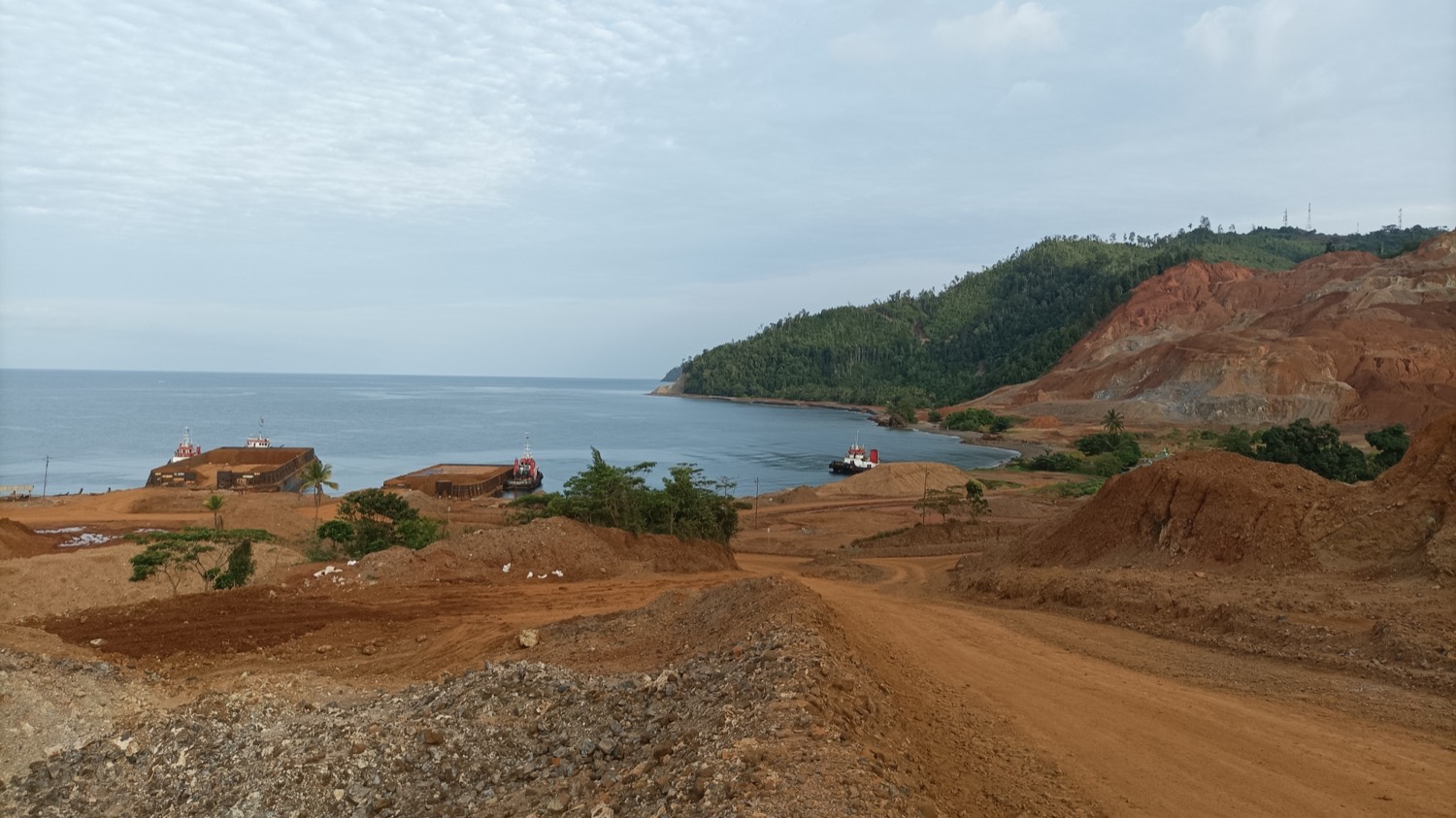
Notes — mine and plant coordinates are approximate. Tonnages are nickel content unless stated; RKAB quota figures are wet tonnes of ore. Refined-share figures follow the IEA basis (metal, NPI, ferronickel, sulphate) unless INSG's primary-production basis is cited. Class-1 ≈ 25% of supply is an analyst convention (ING), not an official statistic. Last data refresh: August 2026. Header photo: nickel-ore mining area on the coast of North Kolaka, Southeast Sulawesi, Indonesia — Marwan Mohamad via Wikimedia Commons, CC BY-SA 4.0.
FAQ
Common questions
What is nickel used for?
Mostly to make steel stainless: about 64% of the world's nickel goes into stainless steel, the 300-series kitchens, hospitals and chemical plants are built from (Wood Mackenzie, 2024). Batteries take roughly 15% — the nickel-rich NMC and NCA cathodes in longer-range EVs — with the rest split between non-ferrous alloys, electroplating and alloy steels. The strategic sliver is superalloys: nickel-based alloys make up 40–50% of a modern jet engine's weight, with no substitute at any price.
Which country produces the most nickel?
Indonesia, by an enormous margin: about 2.6 million of the world's 3.9 million tonnes in 2025 (USGS) — roughly two-thirds of global mine supply, up from around 5% a decade ago. The Philippines is a distant second at about 270,000 tonnes, much of its ore now shipped to Indonesian plants. Downstream the grip tightens differently: Indonesia is now the largest refiner too — 45% of the world's refined nickel in 2025, ahead of China's 31% (IEA), because the smelters were made to come to the ore — and Chinese groups own roughly three-quarters of Indonesia's refining capacity.
What happened in the 2022 LME nickel squeeze?
On 8 March 2022, LME nickel jumped 250% in two days and traded past $100,000 a tonne as a huge short position held by Tsingshan — the world's biggest nickel producer — collided with Russia-invasion supply fears. The LME suspended trading for more than a week and retroactively cancelled about 9,000 trades worth roughly $12 billion. Hedge funds sued and lost; the UK regulator later fined the exchange £9.2 million — its first-ever enforcement action against an exchange. Volumes only recovered to pre-crisis levels in 2024.
What is the difference between class-1 and class-2 nickel?
Class-1 is refined metal of at least 99.8% purity — the cathode and briquettes the LME contract actually delivers — and makes up only about a quarter of supply. Class-2 is the rest: nickel pig iron and ferronickel, iron-nickel alloys that go straight into stainless steel. NPI alone was over half of world supply in 2025 (INSG). The boundary is blurring: Indonesian plants now convert NPI to matte and laterite ore to MHP, intermediates that Chinese refineries turn into battery-grade sulphate — and increasingly into new class-1 metal that has flooded LME warehouses.
Why did Western nickel mines shut down?
Five consecutive years of Indonesian-driven surplus crushed the price from about $25,800 a tonne (2022 average) to about $15,000 in 2025 — below the cost of most non-Indonesian supply. In 2024 alone, BHP suspended its entire Nickel West division, First Quantum halted Ravensthorpe, Wyloo closed its Kambalda mines and Glencore walked away from Koniambo in New Caledonia after sinking $9 billion. USGS data shows Australian output fell 54% in 2025. Most restarts are judged to need sustained prices above $18,000–20,000 a tonne.
Do EV batteries still need nickel?
The long-range ones do: nickel-rich NMC and NCA cathodes still deliver the highest energy density, and solid-state designs pair with high-nickel cathodes too. But nickel-free LFP became the world's dominant EV chemistry in 2025 (IEA), and battery nickel demand actually dipped slightly that year (INSG). The IEA still projects batteries growing from roughly 15% of nickel demand today to about 30% by 2035 — while advising forecasters to revise nickel demand estimates down as LFP spreads.
Does Africa produce much nickel?
Very little. Africa mined about 3% of the world's nickel in 2024 — Madagascar's Ambatovy plant about 1%, South Africa about 0.7% and Côte d'Ivoire about 0.7% — and holds about 5% of reserves, according to BGS and World Bank data compiled in the OECD's 2026 review of African critical minerals. No African country ranks among the top producers, and IEA-based projections do not see one by 2040. The projects that could change that are Kabanga in Tanzania and the Selebi restart in Botswana. Source: OECD (2026).
Is the world running out of nickel?
No. USGS puts reserves above 140 million tonnes — around 35 years at the 2025 mining rate — with identified resources over 350 million tonnes on land and an estimated 4.5 billion tonnes more in seabed deposits. The real anxieties are concentration and depletion of the best ore: two-thirds of mine supply comes from one archipelago whose quota decisions now set the world price, and Indonesian officials have warned their high-grade saprolite could run short within a couple of decades at the current smelting rate.
Need a deep-dive report on nickel?
That's exactly what we do. We produce commissioned deep-dive reports on nickel, covering angles such as mine-to-refinery supply-chain mapping, Indonesia's quota and royalty regime, the class-1/class-2 divide and what it means for batteries versus stainless, the LME's post-squeeze credibility, Western restart economics and the seabed-nodule wildcard. Every report is source-cited — charts, maps and citations included — and built on the same open, verified data behind this dashboard. Email hello@mineral.watch with a short note on what you need and we'll come back with a scoped proposal.
Custom research
Need an ad hoc data-driven research report?
We produce bespoke, source-cited research on nickel and other strategic minerals — supply-chain mapping, trade-flow analysis, country and commodity deep-dives — built on the same open data behind this dashboard.
mineral.watch is an independent data hub, and it grows with the people who use it. Introduce yourself and we'll let you know when the nickel figures on this dashboard are updated and when new dashboards, datasets and research go live — no noise, just what's new.
Telling us your sector and organisation helps too: it shows us who relies on this data — analysts, policymakers, journalists, researchers — and shapes what we build next, from new minerals to custom research.
Prefer to talk directly? Corrections, data tips and collaboration ideas are always welcome at hello@mineral.watch.
.jpg)