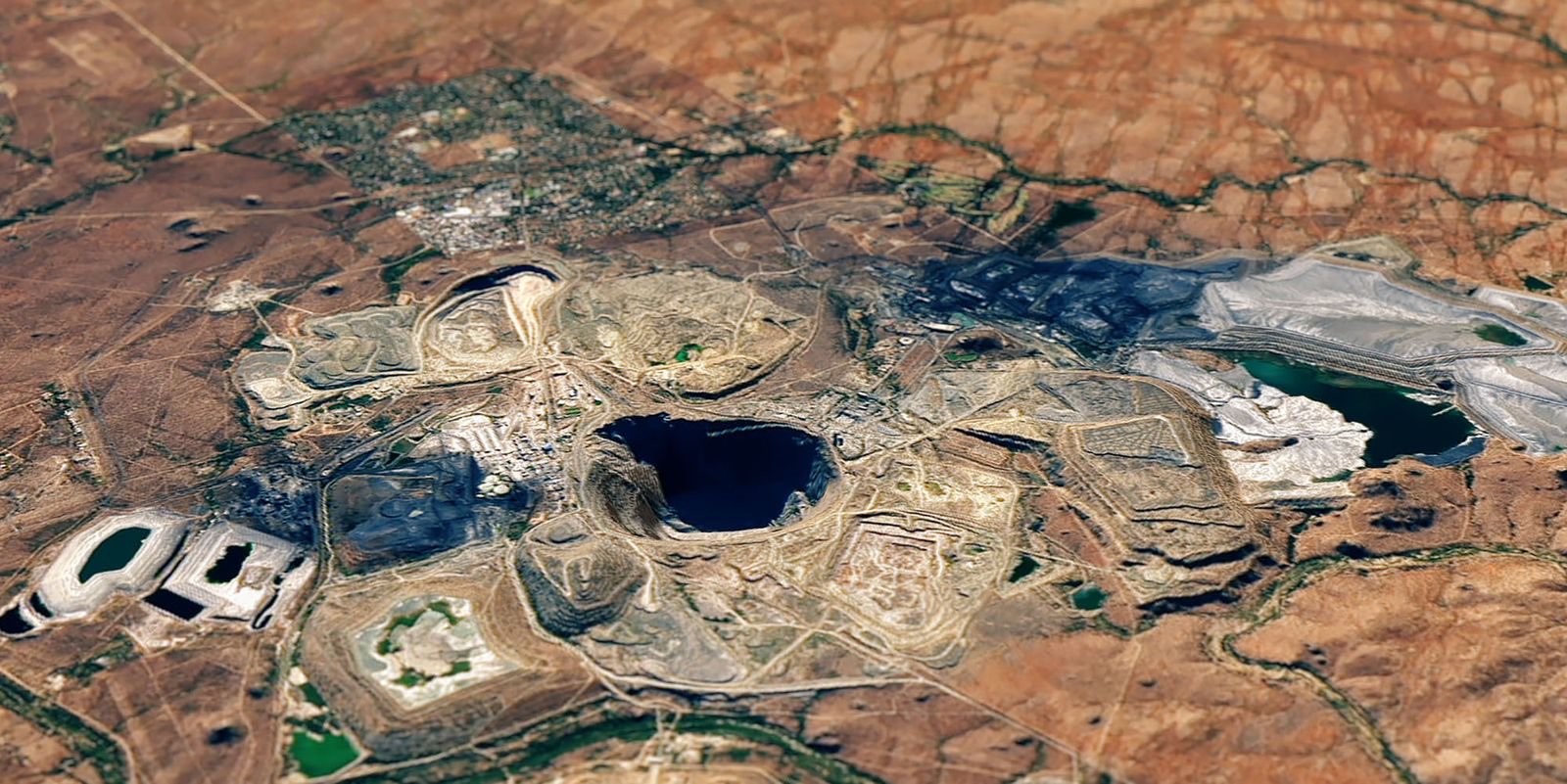
Manganese is the quiet workhorse of industry — nine tonnes in ten harden steel, and USGS says it has no satisfactory substitute. It is dug in enormous volumes in South Africa, Gabon and Australia, hauled down single railway lines, and refined — almost entirely in China — into the alloys behind every building and the battery salts behind the next EV chemistry. This site tracks where manganese is mined, smelted and refined, how a cyclone doubled its price, and why a metal this common became this strategic — using open data from USGS, the IEA, BGS and price agencies.
0of manganese content mined worldwide in 2025 — up 7% in a year (USGS)
0of manganese demand is steelmaking — no satisfactory substitute (USGS)
0of battery-grade manganese sulphate is refined in China (IEA)
0US net import reliance — no domestic manganese mine since 1970 (USGS)
Interactive map
The manganese world map
Mines, ferroalloy smelters and battery-grade refineries, disrupted operations and development projects — including the seabed. Tap a marker for details; toggle layers below. Circle size ≈ scale of operation.
Manganese trades in a ladder of forms — ore graded by percentage, bulk alloys for steel mills, refined metal and battery salts measured in parts per million of impurity. The tonnage lives at the bottom of the ladder; the strategy lives at the top. Tap a stage.
From a 37% ore seam in the Kalahari to the girder in a skyscraper — or, for a small but growing share, to the cathode powder in an electric truck. The tonnage is African and Australian; the transformation is overwhelmingly Chinese.
← swipe →
Production & reserves
Where manganese comes from
Mine production by country, 2025
Thousand tonnes of manganese content, log scale (USGS estimates)
Source: USGS Mineral Commodity Summaries 2026. World total ~20 Mt manganese content; 2025 figures are estimates. Ghana's output doubled in a year, lifting it to third place.
Reserves by country
Million tonnes of manganese content (world total ~1.8 billion tonnes)
Source: USGS Mineral Commodity Summaries 2026. South Africa alone holds an estimated 70% of the world's identified manganese resources, nearly all of it in the Kalahari Manganese Field.
The scissors: steady tonnage, wild price
World mine production of manganese ore (Mt gross weight, left) vs the annual-average 44%-ore price CIF China ($/dmtu, right)
Sources: BGS World Mineral Statistics (production, gross weight, 2018–2024); USGS MCS 2026 / CRU Group (price, from 2021). The 2024 average of $5.53 hides the year's ride: ore spiked to nearly $9/dmtu in August after Cyclone Megan, then collapsed below $4 by October.
Explore where manganese ore is mined, country by country since 1970, on the supply-chain map — and why no matching "refined" series exists for manganese.
Smelting & refining
The chokepoint is the refinery
Manganese mining is refreshingly diversified — four countries on three continents lead it, and no one holds more than 40%. The concentration comes after the mine: China smelts most of the world's manganese alloys, makes more than 90% of its refined manganese metal, and refines about 95% of the battery-grade sulphate that every manganese-rich cathode needs.
Refining geography
A world of mines, one country of refineries
🇨🇳The manganese triangle
Ningxia Tianyuan's complex at Zhongwei and the EMM cluster where Guizhou, Hunan and Chongqing meet — China's "manganese triangle" — refine most of the world's electrolytic manganese metal and sulphate. Built on cheap power and low-grade domestic ore, the industry now runs mostly on imported African rock.
🇿🇦The one exception
Manganese Metal Company in Mbombela, South Africa, is the world's only large-scale refinery of 99.9% manganese metal outside China — running since 1974 on Kalahari ore. Every Western battery-supply-chain plan cites it, because it is essentially the only non-Chinese starting point that already exists.
⚡The electricity trap
Smelting manganese is brutally power-hungry, and the industry migrates to cheap electrons. South Africa — the world's top miner — closed its last ferromanganese smelter at Cato Ridge in May 2025 after power prices rose over 930% since 2008. Malaysia's hydro-powered Sarawak hub grew into a top supplier of US ferroalloys; Ukraine's plants run at a tenth of capacity.
🚧The buildout stumbles
The ex-China battery-grade pipeline is thin and wobbling: Element 25's Louisiana sulphate plant — backed by GM money and a $166M DOE grant — went under review in May 2026 as EV demand softened; Euro Manganese's Chvaletice project in Czechia holds EU strategic status and a fresh economic study but not yet financing; Ghana's $450M refinery is a plan on paper.
Sources: IEA Global Critical Minerals Outlook 2025; USGS MCS 2026; company disclosures (MMC, Assmang, Element 25, Euro Manganese, Ghana Manganese Company); GMK Center.
Where battery-grade manganese sulphate is refined, 2025
Approximate shares of world high-purity manganese sulphate output — the step every manganese-rich battery needs
Sources: IEA Global Critical Minerals Outlook 2025 (~95%); Benchmark Mineral Intelligence puts it near 96%. Commercial-scale plants outside China exist only in Japan, Belgium and Kazakhstan.
From ore to steel and to cell, step by step
The metallurgical route (top) takes ~90% of every tonne; the battery route (bottom) takes a small share and all the attention. Scroll sideways on mobile →
Manganese demand has tracked steel output since the Bessemer converter — which is why a metal mined at twenty million tonnes a year moves with Chinese construction data. The new variable is the cathode: battery demand is small today and projected to grow roughly eightfold this decade.
🏗Steel
About 90% of all manganese deoxidises and hardens steel — typically 0.5–1% of every tonne, far more in wear-resistant grades. That chains demand to global steel consumption, which the World Steel Association estimated flat in 2025: the reason ore prices sat near decade lows even as the battery story took off.
🔋Batteries
The fastest-growing buyer. Manganese dioxide has powered dry cells for a century; lithium-ion NMC cathodes made it an EV metal; and LMFP and lithium-manganese-rich (LMR) chemistries — plus manganese-based sodium-ion — lean on it harder still. Benchmark projects battery demand for manganese to grow more than eightfold this decade.
🥫Aluminium & chemicals
The quiet remainder: manganese stiffens the 3004 alloy of nearly every beverage can, feeds fertilisers and animal nutrition, colours brick and glass, and — as potassium permanganate — treats drinking water. Small tonnages, but embedded in daily life on every continent.
🧪The chemistry shift
The bet reshaping the market: GM and LG Energy Solution plan LMR prismatic cells for US electric trucks by 2028 — pre-production starts late 2027 — promising 400-mile range at LFP-like cost, while Chinese cathode makers scale LMFP. If either wins share, manganese joins lithium as a headline battery metal.
>8×projected growth in battery demand for manganese this decade (Benchmark Mineral Intelligence) — from a base so small that steel will still dominate, but concentrated entirely in the high-purity forms China controls.
Geopolitics
A cyclone, a ban and the seabed
Manganese spent decades as the commodity nobody watched. Then a war idled Europe's mining basin, one storm doubled the world price, Gabon set a deadline to keep its ore at home, and Washington opened a permitting route to the bottom of the Pacific.
2022–
War idles Europe's manganese basin
Russia's invasion puts Ukraine's Nikopol basin — historically one of the world's great manganese districts — on the front line. The Pokrov and Marganets mines fall practically idle, the rail link between them is destroyed, and Ukraine's ferroalloy plants sink to roughly 10% of capacity by 2025. Manganese lands on the critical-minerals list of the US–Ukraine resources agreement.
Mar 2024
Cyclone Megan breaks the market
The storm wrecks the export wharf at South32's GEMCO mine on Groote Eylandt — roughly a tenth of world supply and a far bigger share of high-grade ore. Panic buying drives 44%-grade ore from about $4 to nearly $9/dmtu by August. Then China's steel slump bites: port stocks swell toward 6 million tonnes and the price collapses below $4 by October. Boom and bust inside seven months.
May 2025
The battery moment — and a restart
GM and LG Energy Solution announce they will commercialise lithium-manganese-rich (LMR) cells for US electric trucks by 2028, the loudest Western endorsement yet of manganese-heavy chemistry. The same week, South African coal miner Exxaro agrees to buy into the Tshipi Borwa mine, and GEMCO ships again after fourteen months of repairs.
May–Jun 2025
Gabon sets a deadline
Libreville announces a ban on exporting raw manganese ore from 1 January 2029, following the resource-nationalist playbook of Indonesia's nickel and Zimbabwe's lithium. Eramet's shares slide — its Comilog subsidiary mines nearly all of Gabon's ore — and a later memorandum sketches three processing plants for 2028–2031, the largest due only after the ban bites. The deadline stands; the timetable doesn't add up yet.
May–Aug 2025
The smelting map redraws
Assmang permanently shuts Cato Ridge — South Africa's last ferromanganese smelter, felled by electricity prices up over 930% since 2008 — leaving the world's top miner smelting almost nothing. The energy-cheap winners keep gaining: Malaysia's Sarawak hub is now among America's largest ferroalloy suppliers. By October, USGS notes 2025 ore prices running 22% below 2024's average.
Jan–Feb 2026
Africa moves up the ladder
Ghana Manganese Company — 90% owned by China's Tianyuan Manganese Industry — unveils a $450M refinery at Nsuta to upgrade its 27% ore toward 40% and battery grades, after Ghana's output doubled in 2025 to make it the world's No. 3 producer. Exxaro closes its Tshipi deal on 27 February, becoming the Kalahari's newest major owner.
2025–2026
The nodule race goes official
An April 2025 US executive order revives a 1980 law as a national permitting route for seabed mining, bypassing the deadlocked International Seabed Authority. The Metals Company files a consolidated application in January 2026 for the first commercial recovery permit in the Clarion-Clipperton Zone; NOAA rules it compliant on 1 May and publishes it in the Federal Register on 19 August. A decision is expected by early 2027 — the ISA calls the route illegal.
May–Aug 2026
Reality check
Element 25 puts its GM- and DOE-backed Louisiana sulphate plant under review as US EV demand softens — the West's flagship HPMSM project, wobbling. Eramet's recovery runs the other way: ore output up 6% in H1 2026 on a debottlenecked railway, full-year guidance of 6.4–6.8 Mt, and €225M in fresh rail financing. August 2026 ore prices sit near $5/dmtu — closer to the floor than the 2024 fireworks.
Sources: USGS MCS 2026; Fastmarkets; S&P Global; GMK Center; company and government disclosures (South32, Eramet/Comilog, Exxaro, Assmang, GM/LG Energy Solution, Ghana Manganese Company, The Metals Company, NOAA).
Trade & prices
A bulk trade priced by the percentage point
Manganese has no LME contract. Ore trades by grade in dollars per dmtu — one dmtu is 10 kg of contained metal — alloys trade on Chinese futures and regional assessments, and refined products are priced almost entirely inside China. The flows are simple: African and Australian rock sails east, alloys and refined metal sail back.
US manganese import sources
Manganese contained in principal imports, average 2021–2024 — Malaysia mines nothing yet ranks third, on smelting alone
Source: USGS MCS 2026. By product: ore comes from Gabon (64%), South Africa (24%) and Mexico (12%); ferromanganese from Malaysia, Australia and Norway; silicomanganese from Georgia, South Africa and Australia. Net import reliance: 100%.
Source: USGS MCS 2026 (CRU Group assessments). The 2024 bar hides an intra-year spike to ~$8.97/dmtu in August after Cyclone Megan, and a collapse below $4 by October. August 2026 offers sat near $5/dmtu.
Three prices, one metal
What you pay depends on which rung of the ladder you stand on
The ore price
Graded and indexed: high-grade Gabonese and Australian lump (44–46% Mn), South African semi-carbonate (36.5%), Ghanaian carbonate (~27%). Benchmarks are CIF Tianjin — $4.50/dmtu average in 2025 — because China is the buyer that sets the marginal tonne.
The alloy price
Silicomanganese — the workhorse alloy steel mills actually buy — trades as a futures contract on China's Zhengzhou exchange, making Mn alloys one of the few China-listed bulk ferroalloys. Tender prices from Chinese steel mills ripple straight back into what miners in the Kalahari earn.
The refined price
Electrolytic metal and battery-grade sulphate are priced almost entirely inside China, where overcapacity keeps margins thin — cited by Western developers as the reason their plants can't reach financing. Cheap refined manganese is exactly what makes the 95% chokepoint so hard to compete away.
The missing benchmark
No terminal market, no warehouse stock to watch, no transparent forward curve outside China: manganese price discovery runs on index assessments and mill tenders. When supply breaks — as in 2024 — the market finds the new price violently, because nothing dampens it.
Sources: USGS MCS 2026 (CRU); Fastmarkets; SMM; Zhengzhou Commodity Exchange data via trade press.
The quiet risers: Ghana and Côte d'Ivoire
West Africa is the fastest-changing corner of the supply map
Ghana doubled output to about 2 million tonnes of manganese content in 2025, vaulting past Australia into third place, as Ghana Manganese Company — 90% owned by China's Tianyuan Manganese Industry — pushed the century-old Nsuta mine to records (700,000 tonnes of ore targeted in August 2026 alone). Côte d'Ivoire produced ~350,000 tonnes from smaller mines. Nearly every tonne ships to China as low-grade carbonate ore, and Accra is now following the Gabonese script: a $450M refinery to keep more of the value — and eventually battery-grade product — on shore.
~12%of world mine supply came from Ghana and Côte d'Ivoire in 2025 (USGS) — West African carbonate ore has become the marginal feed for China's refineries, and its governments know it.
Sources: USGS MCS 2026; Ghana Manganese Company and Ministry of Lands announcements; Ecofin Agency.
The Africa view: the OECD's 2026 regional review
What the OECD's 2026 regional review of African critical minerals adds. Its production shares are for 2024 (USGS Mineral Commodity Summaries 2025 basis), a year behind the charts above; its 2040 figures are the authors' calculations from the IEA Critical Minerals Data Explorer.
🗺More mined than mapped
Gabon mines about a quarter of the world's manganese (5.0 of ~20 Mt in 2025, charted above) but holds only about 3% of reserves (61 Mt of ~1.8 Bt). The OECD, using 2024 figures (23.2% vs 3.6%), reads such gaps as a sign that African reserves are underestimated for lack of exploration rather than proof of unusually cheap ore. Africa's share of global exploration spending fell from 16% in 2004 to 10.4% in 2024.
🌍Four countries, three-quarters of supply
South Africa, Gabon, Ghana and Côte d'Ivoire mined 66% of the world's manganese in 2024 on the OECD's count; on USGS's 2025 estimates charted above, Ghana's doubling lifts them to about 75%. Manganese and cobalt are the only two of the six minerals the OECD studied where Africa as a whole is a notable producer.
⚖️The cost of going it alone
Gabon's 2029 raw-ore ban is the test case for the OECD's warnings: export bans cut export earnings, can push domestic ore prices below world prices (good for local processors, bad for miners), may drive disinvestment, and almost always fall foul of WTO rules — a WTO panel sided with the EU against Indonesia's nickel-ore ban. It argues for regional processing hubs that pool ore from several countries.
📜Strategies on paper
South Africa published a critical-minerals strategy in 2025, and the African Union's 2025 African Green Minerals Strategy names manganese a core battery mineral. But the OECD finds comprehensive strategies widely missing, and the African Minerals Development Centre — the AU's implementing arm — has been ratified by only 4 of the 15 countries needed to bring it into force.
China mines barely 4% of the world's manganese — its domestic ore is thin and low-grade — yet dominates every step after the mine. Like lithium conversion and unlike rare earths, the grip isn't geological; it was built on cheap power, scale and two decades of Western indifference to a "boring" steel additive.
~95%
of the world's battery-grade manganese sulphate is refined in China (IEA). Its share along the mine-to-battery chain:
Sources: USGS MCS 2026 (mine production, 2025); ferroalloy share ~60% (USGS Minerals Yearbook and industry estimates); IEA Global Critical Minerals Outlook 2025 (battery-grade sulphate ~95%); EMM share >90% with Manganese Metal Company (South Africa) the only large-scale producer elsewhere.
Dual use
No manganese, no steel, no arsenal
Manganese was one of the first minerals ever stockpiled for war, because armour, helmets, gun barrels and ship hulls are all manganese steels. A century later the Pentagon still holds it — and is now swapping steel-age stockpiles for battery-age ones.
🛡Hadfield's armour
Steel alloyed with 12–14% manganese — invented by Robert Hadfield in 1882 — hardens as it's struck, which is why it became the material of tank tracks, WWI helmets, rail crossings and rock crushers. Modern armour plate and ballistic steels still lean on manganese; there is no manganese-free route to hard steel.
🚢Hulls, barrels and shells
Naval hull plate, artillery gun steel, shell casings and the structural steel of every base and bridge carry manganese as deoxidiser and hardener. It is the least glamorous defence mineral precisely because it is in everything — a war economy consumes manganese in proportion to its steel.
📦The stockpile pivot
The US National Defense Stockpile has held manganese since WWII. Its FY2025 plan tells the modern story in one line: authority to sell 292,000 t of metallurgical ore and 18,000 t of ferromanganese — while acquiring electrolytic manganese metal, the battery-relevant form the US cannot make.
🔋The battlefield goes electric
Drones, soldier-worn power and hybrid vehicles pull defence demand toward the same manganese-rich cells the EV market is scaling — and toward the same Chinese sulphate chokepoint. Beijing's July 2025 export controls on LFP and LMFP cathode technology showed how quickly that leverage can be exercised.
🌊Nodules as strategy
The 2025 seabed-minerals executive order framed Pacific nodules — roughly 30% manganese, with nickel, cobalt and copper — as a strategic reserve, and NOAA is processing the first commercial permit application. If it proceeds, the US would source manganese from the seabed before it re-learns to refine it on land.
🏛Critical by every list
Manganese sits on the US, EU, Japanese and Indian critical-minerals lists; high-purity manganese is an EU strategic raw material with 2030 processing targets; the US Section 232 investigation into processed critical minerals covers it; and it appears in the US–Ukraine minerals agreement.
Sources: USGS MCS 2026 (Government Stockpile table); DLA Strategic Materials; Federal Register; EU Critical Raw Materials Act; MOFCOM announcements via trade press; historical metallurgy literature.
Capital flows
Where the manganese money is going
For decades manganese attracted no capital because it needed none — ore was cheap, abundant and boring. The battery story and the export-ban wave changed the question: the money now chases refining capacity, logistics and the seabed. Presented as observation, not investment advice.
🤝Exxaro's pivot
South Africa's coal heavyweight bought its way into the Kalahari, closing the acquisition of Ntsimbintle's 50.1% of Tshipi Borwa — the country's largest single manganese exporter — in February 2026, with the Mokala stake to follow. A bet that the world's biggest ore endowment beats a declining coal market.
🚂Eramet doubles down on rail
Comilog's ceiling has never been the Moanda mine — it's the single-track Transgabonais railway. Eramet raised €225M in 2026 to renovate and expand it, targeting more than 8 Mt of annual capacity, while negotiating processing plants against Gabon's 2029 raw-ore export ban. The mine is a licence; the railway is the business.
🏛Governments as anchor investors
Washington granted Element 25's Louisiana plant a $166M DOE award with GM adding $85M in debt; the EU handed Chvaletice strategic-project status; Ghana's state keeps 10% of GMC and a refinery ambition. Every non-Chinese battery-grade project leans on a state balance sheet — none has reached production.
🌊The nodule speculation
The Metals Company turned a regulatory bet into a listed proxy for seabed mining: a NOAA permit expected by early 2027, an Allseas contract for the first commercial collection system, and billions of tonnes of ~30%-manganese nodules behind it. High ceiling, binary risk — legal, environmental and political.
⚠️The risks
Prices sit near decade lows and demand is chained to flat global steel. China's overcapacity in EMM and sulphate can underprice any new entrant — Element 25's 2026 review shows the financing bar. Export-ban politics cut both ways, battery demand is still a single-digit share, and the 2024 spike proved how fast this market gives back a rally.
♻️The missing circular economy
USGS calls dedicated manganese recycling "negligible": the metal disperses into steel and is recovered only incidentally in scrap and slag. Battery recycling will eventually return cathode manganese, but the feedstock barely exists yet — a rare major metal with essentially no secondary supply cushion.
This section describes where capital is flowing, based on public data. It is not financial advice.
Sources: company and government disclosures (Exxaro, Eramet, Element 25, Euro Manganese, TMC); US DOE; EU Commission; USGS MCS 2026.
Company tracker
The companies that move manganese
Miners, smelters, refiners and developers across the chain. Four mining houses dominate the ore trade; one Chinese company leads the refined market; and a handful of Western developers are trying to build the missing middle. Filter by segment or search.
Company
Segment
Key assets
Status & recent signals
Company status reflects public disclosures as of August 2026. This is an observational tracker, not investment advice.
Sources: company disclosures & filings; USGS MCS 2026; trade press (Reuters, MINING.com, Fastmarkets, S&P Global, GMK Center, Ecofin Agency).
Data & methodology
Open data sources
USGS Mineral Commodity Summaries 2026 — Manganese — world mine production, reserves and resources, US trade, prices, stockpile and end-use notes. 2025 figures are estimates; production is manganese content.
IEA Global Critical Minerals Outlook 2025 — refining-concentration estimates, including China's ~95% share of high-purity manganese sulphate, and demand scenarios for battery chemistries.
Prices — CRU Group annual averages (the series USGS publishes); Fastmarkets and SMM ore indices; Zhengzhou Commodity Exchange silicomanganese futures via trade press.
Ukraine — GMK Center reporting on the Nikopol basin and ferroalloy industry.
OECD (2026), Critical minerals in Africa: a regional overview — OECD Global Relations Policy Papers 2026/7, authored by a European Council on Foreign Relations team (CC BY 4.0): Africa's share of manganese production and reserves, IEA-based projections to 2040, African export bans, quotas and levies, and the policy findings in the "Africa view" card. Its production shares are 2024 figures (USGS MCS 2025 basis); this page keeps the newer USGS MCS 2026 numbers.
Notes — mine and plant coordinates are approximate. Production tonnages are manganese content unless stated as gross ore weight (BGS series). 1 dmtu = 10 kg of contained manganese per tonne of ore. Refining shares are IEA/Benchmark/industry estimates. Last data refresh: August 2026.
FAQ
Common questions
What is manganese used for?
About 90% of manganese goes into steelmaking, where it removes oxygen and sulfur from molten iron and hardens the finished steel — USGS states flatly that manganese has no satisfactory substitute in its major applications. The rest goes into aluminium alloys (every beverage can), batteries (alkaline cells and, increasingly, lithium-ion cathodes), fertilisers, animal feed and water treatment. Batteries are the fastest-growing use: demand from that segment is projected to grow around eightfold this decade.
Which country produces the most manganese?
South Africa mined about 7.6 million of the world's 20 million tonnes of manganese content in 2025 (USGS), from the Kalahari Manganese Field — which also holds roughly 70% of the world's identified resources. Gabon came second at about 5 million tonnes and Ghana leapt to third at about 2 million after doubling output in a year. But the leverage sits downstream: China refines more than 90% of the world's manganese metal and about 95% of battery-grade manganese sulphate.
Is the world running out of manganese?
No. USGS puts reserves at about 1.8 billion tonnes of manganese content — roughly 90 years at the 2025 mining rate — before counting the billions of tonnes lying in polymetallic nodules on the Pacific seabed. The risk is not geology but structure: ore is cheap and abundant, so almost nobody outside China has built the refineries that turn it into battery-grade product, and 100% of US consumption is imported.
Why did the manganese price spike in 2024?
In March 2024, Cyclone Megan destroyed the export wharf at South32's GEMCO mine on Groote Eylandt, Australia — roughly a tenth of world supply and a much larger share of high-grade ore. Panic buying drove 44%-grade ore from about $4 to nearly $9 per dmtu by August. Then China's steel slump caught up: port stocks swelled to about 6 million tonnes and prices collapsed below $4 by October. GEMCO resumed exports in May 2025; the 2025 average was $4.50/dmtu.
What is manganese's role in batteries?
Manganese has powered alkaline batteries for a century, and in lithium-ion it is the cheap, stable ingredient in NMC cathodes. The next wave leans on it harder: LMFP and lithium-manganese-rich (LMR) chemistries promise near-nickel energy at LFP-like cost — GM and LG Energy Solution plan LMR production for US electric trucks by 2028, and Chinese cathode makers are scaling LMFP. Every one of those routes runs through high-purity manganese sulphate, about 95% of which is refined in China.
What are manganese nodules?
Potato-sized lumps on the abyssal Pacific seafloor that are roughly 30% manganese, plus nickel, cobalt and copper. The Clarion-Clipperton Zone alone holds billions of tonnes. After a 2025 US executive order opened a national permitting route, The Metals Company applied to NOAA for the first commercial recovery permit; NOAA found the application compliant in May 2026 and published it for comment that August, with a decision expected by early 2027 — over the objections of the International Seabed Authority, which says international waters are not America's to license.
Need a deep-dive report on manganese?
That's exactly what we do. We produce commissioned deep-dive reports on manganese, covering angles such as ore-to-sulphate supply-chain mapping, mine supply and export logistics from South Africa, Gabon, Ghana and Australia, China's grip on battery-grade refining, what LMFP and LMR chemistries mean for future demand, and steel-market dynamics alongside the seabed-nodule question. Every report is source-cited — charts, maps and citations included — and built on the same open, verified data behind this dashboard. Email hello@mineral.watch with a short note on what you need and we'll come back with a scoped proposal.
Custom research
Need an ad hoc data-driven research report?
We produce bespoke, source-cited research on manganese and other strategic minerals — supply-chain mapping, trade-flow analysis, country and commodity deep-dives — built on the same open data behind this dashboard.
mineral.watch is an independent data hub, and it grows with the people who use it. Introduce yourself and we'll let you know when the manganese figures on this dashboard are updated and when new dashboards, datasets and research go live — no noise, just what's new.
Telling us your sector and organisation helps too: it shows us who relies on this data — analysts, policymakers, journalists, researchers — and shapes what we build next, from new minerals to custom research.
Prefer to talk directly? Corrections, data tips and collaboration ideas are always welcome at hello@mineral.watch.