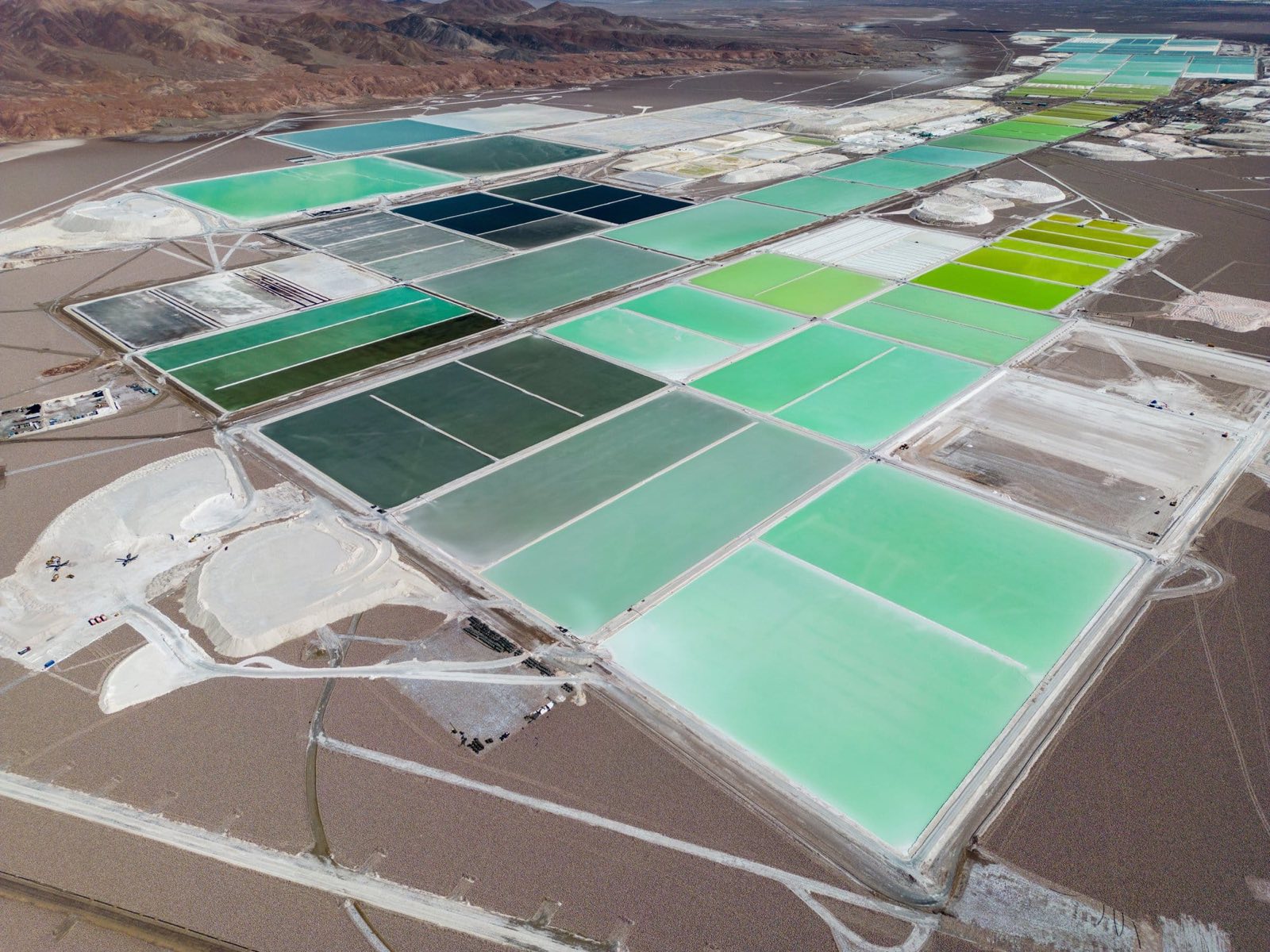
Lithium is the irreplaceable ion of the battery age — every EV, grid battery, phone and drone stores its energy in it. It is mined from Australian rock and Andean brine, but nearly every tonne must pass through a conversion plant, and most of those are in China. This site tracks where lithium is mined, converted and consumed, and how a boom, a bust and one idled Chinese mine keep whipsawing the price — using open data from USGS, the IEA, BGS and price agencies.
0lithium mined worldwide in 2025 — up 31% in one year (USGS)
0of world lithium demand is batteries (USGS, 2025)
0of the world's lithium chemicals are refined in China (IEA est.)
0per tonne — carbonate's 2022 average; it fell to $9,000 by 2025, then roughly doubled in 2026
Interactive map
The lithium world map
Hard-rock mines, brine operations, conversion plants, curtailed operations and development projects. Tap a marker for details; toggle layers below. Circle size ≈ scale of operation.
Why Argentina — about 7% of the world's lithium-chemical conversion (IEA / Benchmark) — has almost no converter markers: its salares finish the job on site. Fénix, Olaroz, Cauchari-Olaroz, Centenario-Ratones, Tres Quebradas and Rincon evaporate or DLE-extract the brine and precipitate lithium carbonate at the salar itself, so the brine markers there are also the country's converters; the one refinery marker is POSCO's Güemes hydroxide plant, fed from Sal de Oro. Chile splits the two steps — brine pumped at the Salar de Atacama, carbonate and hydroxide made on the coast at Salar del Carmen and La Negra — which is why it gets separate refinery markers. China's Qinghai and Tibet salt lakes likewise produce carbonate on site.
From ore to electrons
One element, two supply chains
Lithium trades in a ladder of forms — rock, brine, concentrate, chemical, cathode — and unlike copper there is no single exchange-traded metal at the end of it. Each rung is its own market with its own price, and the chokepoints sit between the rungs. Tap a stage.
From a per-cent of an Australian rock or a fraction of a per-cent of an Andean brine to the cathode powder in an EV cell, lithium crosses more borders than almost any other battery material — and the geography narrows hard in the middle.
← swipe →
Production & reserves
Where lithium comes from
Mine production by country, 2025
Thousand tonnes of lithium content, log scale (USGS estimates)
Source: USGS Mineral Commodity Summaries 2026. World total ~290 kt (excludes US output, which is withheld); 2025 figures are estimates.
Reserves by country
Million tonnes of lithium content (world total ~37 Mt)
Source: USGS Mineral Commodity Summaries 2026. Identified resources are far larger: ~150 Mt worldwide, led by the US (30 Mt), Argentina (28 Mt) and Bolivia (23 Mt).
The scissors: production up 3×, price on a rollercoaster
World mine production (kt lithium content, left) vs the USGS annual-average battery-grade carbonate price ($/t, right)
Sources: USGS Mineral Commodity Summaries, successive editions (production, as revised; excludes US); USGS MCS 2026 (price series, from 2021). 2026 spot rebounded to roughly $18,000–23,000/t by August.
Compare where lithium is mined against where it is refined, country by country since 1970, on the mined-vs-refined supply-chain map.
Conversion & refining
The chokepoint is the converter
Lithium mining spans five continents and no country digs more than a third of it. The concentration comes one step later: almost every tonne of spodumene — Australian, African, Brazilian or Canadian — ships to China to be converted into battery-grade carbonate or hydroxide. China makes roughly 70% of the world's lithium chemicals and 85% of its cathode material.
Conversion geography
A world of mines, a province of converters
🇨🇳The conversion belt
Jiangxi's lepidolite district around Yichun, the spodumene converters of Sichuan and the brine plants of Qinghai and Tibet form the engine room of the battery age. Chinese converters were built faster than mines could feed them — so China imports rock from three continents to keep them running.
🎚️The swing producer
CATL's Jianxiawo mine — roughly 3–6% of world supply, near the top of the cost curve — has become the market's throttle. Its August 2025 permit lapse more than doubled futures; its June 2026 restart permit knocked them straight back down. Rarely has one asset so visibly set a global price.
🌍The ex-China buildout
Diversification is under way but hard: Australia's Kwinana and Kemerton hydroxide plants have run below plan for years, while Tesla's Corpus Christi refinery, AMG's Bitterfeld plant in Germany, Chile's expanding carbonate lines and Kwinana's new Mt Holland refinery are the first serious non-Chinese additions.
🚫The technology wall
In 2025 Beijing added lithium-processing and battery technologies to its export-control lists — July for battery and cathode know-how, 9 October for the wider lithium-ion supply chain — making it harder to clone Chinese refining abroad just as everyone was trying to.
Sources: IEA (Global EV Outlook 2026, critical-minerals commentaries); Benchmark Mineral Intelligence; USGS MCS 2026; company disclosures.
Where lithium chemicals are made, 2025
Approximate shares of world battery-grade conversion output — the step where the market concentrates
Sources: IEA and Benchmark Mineral Intelligence estimates; shares are approximate. Chile and Argentina convert their own brine; nearly all spodumene is converted in China.
From rock and brine to battery, step by step
Hard-rock route (top) and brine route (bottom) converge at battery-grade chemicals. Scroll sideways on mobile →
Route shares: USGS, IEA estimates. SC6 = 6% Li₂O spodumene concentrate. DLE = direct lithium extraction, running at commercial scale in Qinghai and at Eramet's Centenario in Argentina.
Demand
The battery century
Two decades ago lithium went into ceramics, grease and the odd laptop. Now 88% of it goes into batteries, demand is about six times its 2015 level, and the two engines — electric vehicles and grid storage — are both still accelerating.
🚗Electric vehicles
One in four cars sold worldwide in 2025 was electric (IEA), and EV batteries absorbed about 1.2 TWh of cells — up nearly 30% in a year. China and Europe drove the growth; the US market cooled after its purchase credit expired in September 2025.
🔋Grid storage
The fastest-growing buyer: battery energy storage now takes over 15% of all cells and rising, as solar-plus-storage undercuts gas peakers. USGS credits the storage boom, alongside EVs, for the demand surge that flipped the lithium market in late 2025.
🏺Everything else
The legacy 12%: ceramics and glass (4%), lubricating greases (2%), air-treatment systems, continuous-casting fluxes and lithium pharmaceuticals. These uses once defined the market; now they are a rounding error on battery demand.
🧂The sodium shadow
The substitution watch: CATL unveiled its Naxtra sodium-ion battery in 2025 and LFP — the lithium-lightest chemistry — already powers over half of new EVs. Cheaper chemistries cap the price spikes, but every one of them still needs lithium except sodium, which is only nibbling at the cheap end.
>3 TWhthe IEA's projection for annual battery demand by 2030 — more than double 2025's deployment. Lithium demand grew 20% in 2025 alone (USGS); the IEA sees it growing faster than any other critical mineral through 2040.
Geopolitics
Boom, bust, boom
No commodity this decade has whipsawed like lithium: a sevenfold price spike, an 85% crash, a state takeover in Chile, a $6.7 billion oil-major-style consolidation — and then one Chinese mine's paperwork moved the world price twice.
2021–2022
The first squeeze
EV sales double in two years and catch the mining industry flat-footed. Battery-grade carbonate averages $63,700/t in 2022 — more than five times the 2021 average — igniting a global rush of mine building from the Pilbara to the Andes, and pulling lepidolite, Africa's pegmatites and recycled black mass into the supply pool.
Apr 2023
Chile reaches for its salares
President Boric announces the National Lithium Strategy: state control over the world's richest brine, with private partners in the minority. SQM — whose Atacama lease was due to expire in 2030 — is pushed to the negotiating table with state copper giant Codelco. In July, China lists lithium carbonate futures in Guangzhou, financialising a market that had priced by private negotiation.
2024
The crash
The mines the boom financed all arrive at once. Prices collapse to 2015 levels; Australia's Bald Hill and Finniss go into care and maintenance, Albemarle mothballs a Kemerton train and slashes capex, and Chinese lepidolite runs at a loss. Contrarians buy the bottom: Rio Tinto agrees to acquire Arcadium for $6.7B (October) and approves a $2.5B expansion of Rincon; Ganfeng's Goulamina in Mali ships its first concentrate (December).
Mar 2025
Big mining buys in
Rio Tinto closes the Arcadium deal — Fénix, Olaroz, Mt Cattlin and a chemicals network — becoming a top-three Western producer overnight and rebranding the unit Rio Tinto Lithium. The message lands industry-wide: the majors now treat lithium like copper, a bet on the decade rather than the quarter.
Aug 2025
Jianxiawo goes dark
CATL's giant lepidolite mine in Jiangxi — roughly 3–6% of world supply — halts when its permit expires amid Beijing's "anti-involution" crackdown on loss-making overcapacity. Guangzhou futures leap; the market discovers that its marginal tonne answers to a battery company and a mining regulator, not to the market.
Sep–Oct 2025
Washington buys equity, Beijing controls tech
The US EV tax credit expires on 30 September, chilling American demand. Weeks later Washington deepens supply-side support: the restructured DOE loan hands the government warrants for 5% of Lithium Americas and 5% of the Thacker Pass JV, with the first $435M advance flowing in October. On 9 October, Beijing extends export controls across the lithium-ion battery supply chain.
Nov–Dec 2025
Chile closes the circle
China's antitrust regulator — reviewing a Chilean JV, a sign of the times — clears the Codelco-SQM partnership in November. In December the joint venture is born: Codelco holds 50%+1 share, SQM operates until 2031, and the Atacama operation is secured to 2060. H2 demand — EVs in China and Europe, grid storage everywhere — has meanwhile flipped the market: carbonate ends 2025 above $10,000 and climbing.
H1 2026
The rebound
With Jianxiawo idle and demand compounding, Guangzhou carbonate futures more than double from the 2025 trough, topping ¥200,000 (~$29,500)/t. Spodumene climbs from $800 (Jan 2025) past $2,000/t. Restarts begin: MinRes reboots Bald Hill in May after an 18-month pause, and on 29 June CATL secures Jianxiawo's new permit — futures drop 10% in two sessions on the news.
Jul–Aug 2026
Restarts temper the rally
Jianxiawo ramps back toward ~62,500 t LCE for 2026 (Benchmark) and analysts pencil a ~78 kt LCE surplus for the year; spot carbonate settles back to roughly $18,000–23,000/t — still about double a year earlier. The next fight is downstream: Zimbabwe's ban on exporting unprocessed concentrates takes effect in January 2027, and Chile's NovAndino JV budgets $3B to lift Atacama output ~70% with direct extraction.
Sources: USGS MCS 2026; Benchmark Mineral Intelligence; Fastmarkets; Guangzhou Futures Exchange data as reported by Reuters, Bloomberg and MINING.com; company and government disclosures (CATL, Rio Tinto, SQM, Codelco, Lithium Americas, US DOE).
Trade & prices
A market still learning to price itself
Lithium has no LME contract and no single price: spodumene, carbonate and hydroxide each trade on assessments, auctions and — since 2023 — Chinese futures. The flows are simple to draw and hard to change: rock goes to China, brine chemicals go everywhere, and the US imports nearly all of what it uses.
US lithium import sources
Average shares 2021–2024 — nearly everything arrives from two South American brine producers
Source: USGS MCS 2026. US net import reliance exceeds 50% of apparent consumption; domestic output comes from a single Nevada brine operation.
The whipsaw, in annual averages
Battery-grade lithium carbonate, US fixed-contract annual average, $/t
Source: USGS MCS 2026 (Benchmark Mineral Intelligence assessments). 2026 spot rebounded to ~$18,000–23,000/t by August after futures briefly topped ¥200,000 (~$29,500).
Three prices, one atom
What you pay depends on which rung of the ladder you stand on
The rock price
Spodumene concentrate (SC6) is priced FOB Australia: $800/t in January 2025, above $2,000/t by mid-2026. Miners' fortunes swing on it — it is set increasingly by auction and by the implied economics of Chinese converters.
The chemical price
Battery-grade carbonate and hydroxide are the headline numbers. Since Guangzhou listed carbonate futures in July 2023, China's exchange has set the world's marginal price — and amplified every supply headline into a double-digit move.
The contract price
Most real tonnes move on fixed or formula contracts that lag spot: the US contract average was $9,000/t in 2025 even as spot doubled late in the year. The gap between contract and spot is where the market's pain — and profit — lives.
The missing benchmark
No terminal market, no deliverable metal, no LME warehouse: lithium is a chemical, not a metal trade. That makes price discovery noisy, hedging hard, and Chinese futures — for better or worse — the closest thing to a world price.
Sources: USGS MCS 2026; Fastmarkets; Benchmark Mineral Intelligence; GFEX data via Reuters and MINING.com.
The quiet risers: Zimbabwe and Mali
Africa went from bit player to the margin that matters in three years
Zimbabwe became the world's fourth-largest producer in 2025 (~28,000 t of lithium content) on the back of five Chinese-owned mines — Bikita, Arcadia, Sabi Star, Kamativi and Zulu — and Mali went from nearly zero to 9,400 t in Goulamina and Bougouni's first full year. Nearly every tonne ships to China as concentrate. Harare is now forcing the value chain home: a ban on exporting unprocessed concentrates takes effect in January 2027, with lithium-sulfate plants under construction at Bikita and Arcadia to keep more of the price on shore.
~13%of world mine supply came from Zimbabwe and Mali in 2025 (USGS) — up from about 1% in 2021. African hard rock has become the swing tonne behind China's converters, and its governments know it.
Sources: USGS MCS 2026; government announcements; company disclosures (Sinomine, Huayou, Chengxin, Ganfeng, Kodal).
The Africa view: the OECD's 2026 regional review
What the OECD's 2026 regional review of African critical minerals adds. Its production shares are for 2024 (USGS Mineral Commodity Summaries 2025 basis), a year behind the charts above; its 2040 figures are the authors' calculations from the IEA Critical Minerals Data Explorer.
🇿🇼Africa's lithium is Zimbabwe — for now
Zimbabwe mined 9.3% of the world's lithium in 2024 and holds nearly all of Africa's 1.6% of reserves on USGS figures; the World Bank puts Africa at 15.9% once announced DRC resources such as Manono are counted. On IEA-based projections Zimbabwe's share slips to about 6% by 2040 as demand grows almost six-fold, and no African country becomes a significant refiner.
🚫Three bans in six months
Zimbabwe banned raw lithium ore exports in December 2022; Namibia banned exports of unprocessed critical minerals in June 2023; Ghana banned raw lithium exports the same month. Of the seven African export bans the OECD lists, three cover lithium. Its advice: check that power, infrastructure, finance and demand can support local processing before banning, then apply the rules transparently.
🇬🇭Ghana's royalty test
Ghana set a 10% royalty on lithium. Then prices fell about 80% from their November 2022 peak, and the internal rate of return at Ghana's flagship project — Atlantic Lithium's Ewoyaa, on the map — dropped from 105% to 13.6%, prompting requests for lower royalties, taxes and import duties. Civil-society groups warn against permanent concessions for a temporary slump.
🇨🇳Chinese capital, Chinese refining
Chinese miners spent about $4.5 billion in 2022–23 securing significant holdings in most of Africa's lithium mines, in Namibia, Zimbabwe and Mali. Plants such as Bikita's new lithium-sulphate line feed China's battery and EV industries directly, which the OECD calls China's structural edge: upstream stakes integrated with midstream processing and downstream demand.
China mines about a fifth of the world's lithium — and converts about seventy per cent of it. Like copper smelting and unlike rare earths, the dominance isn't geological; it was built, converter by converter, in fifteen years, and it deepens at every step from the salt to the cell.
~70%
of the world's battery-grade lithium chemicals are made in China (IEA estimates). Its share along the mine-to-battery chain:
Sources: USGS MCS 2026 (mine production, 2025); IEA Global EV Outlook 2026 and critical-minerals analysis (chemicals ~70%, cathode active materials ~85%, LFP cells >98%). Chinese companies also own or fund most of Zimbabwe's and Mali's output.
Dual use
The battlefield runs on batteries
Drones rewrote the demand signal: modern wars are fought on lithium-ion cells, and modern deterrents were built on lithium isotopes. The Pentagon treats battery supply chains as munitions supply chains now — because they are.
🛸Drones
FPV and reconnaissance drones are consumed like artillery shells — Ukraine alone builds millions a year — and every one flies on lithium-polymer cells. Loitering munitions, robot dogs and one-way attack drones have made small high-density cells a war-stock item.
🌊Submarines & ships
Japan's Taigei-class boats swapped lead-acid for lithium-ion banks, doubling submerged endurance at speed; South Korea followed. Unmanned surface and undersea vehicles — the fastest-growing naval programmes anywhere — are battery-electric by definition.
⚡Lasers & the electric battlefield
Directed-energy weapons, electromagnetic launchers and jammers need pulse power that generators can't deliver alone — lithium batteries buffer it. Soldier-worn power, silent-watch vehicles and expeditionary microgrids all draw on the same cells as EVs.
☢️The isotope legacy
Lithium-6 deuteride is the fusion fuel of thermonuclear warheads — the reason the US enriched lithium at Oak Ridge until 1963 and still husbands the residue. Lithium-7 conditions the water chemistry of most Western reactors; large-scale isotope separation today survives mainly in China and Russia.
📦The stockpile gap
The National Defense Stockpile sold off its lithium decades ago; recent NDAAs directed it back into battery materials, and the Pentagon has used Defense Production Act funds — including a $90M award to restart Albemarle's Kings Mountain mine — to rebuild a domestic chain.
🏛️Critical by every list
Lithium sits on the US, EU, Japanese and Indian critical-minerals lists; the US 2025 Section 232 investigation into processed critical minerals covers it, and the EU Critical Raw Materials Act sets 2030 targets for domestic extraction, processing and recycling that lithium currently misses.
Sources: USGS MCS 2026; DoD and DOE announcements; naval programme disclosures (Japan MoD, ROK Navy); Oak Ridge historical records; Federal Register; press reports.
Capital flows
Where the lithium money is going
The crash shook out the tourists; the rebound is repricing what's left. Majors, oil companies and governments are all buying exposure to the same thesis — that the 2030s need far more lithium than the 2020s financed — presented as observation, not investment advice.
🤝Big mining's bet
Rio Tinto's $6.7B Arcadium takeover (closed March 2025) created Rio Tinto Lithium and validated the countercyclical playbook: buy brine and chemicals at the bottom. Its $2.5B Rincon expansion and stalled Jadar project make it the West's most-watched lithium balance sheet.
🛢️Big Oil goes brine
The Smackover formation under Arkansas and Texas has drawn ExxonMobil (targeting first production late this decade), Chevron (acreage bought 2025) and Equinor (JV with Standard Lithium): drilling, pumping and processing brine is the business they already know — if DLE delivers.
🏛️Governments as shareholders
The state is back on the cap table: Washington holds warrants for 5% of Lithium Americas alongside a $2.26B DOE loan; Chile's NovAndino gives Codelco 50%+1 of the Atacama; Bolivia's Uyuni deals await a new government's blessing; and EU strategic-project status fast-tracks a dozen lithium builds.
🧪The DLE frontier
Direct lithium extraction — pulling lithium from brine in hours instead of pond-years — is running commercially at Eramet's Centenario and across Qinghai, and anchors the $3B Atacama expansion plan. If it scales, oilfield brines, geothermal plants (Vulcan, Salton Sea) and old salares all become orebodies.
⚠️The risks
Analysts still pencil a ~78 kt LCE surplus for 2026 as restarts return — the rebound rests on demand forecasts and Chinese permitting whims. Sodium-ion nibbles from below, contract prices lag spot both ways, and the US demand picture dimmed when the EV credit died. Lithium has now burned momentum investors twice in five years.
♻️The urban salar
Recycling is the sleeping supply source: black-mass capacity keeps growing in China, Korea and the US, and every retired EV battery is ~40 kg of LCE that never needs a pond or a roaster. Before 2035 it stays a side dish — there simply aren't enough dead batteries yet.
This section describes where capital is flowing, based on public data. It is not financial advice.
Sources: company and government disclosures; US DOE; Benchmark Mineral Intelligence; IEA; Reuters; MINING.com.
Company tracker
The companies that move lithium
Miners, brine operators, converters and developers across the chain. A handful of companies in four countries produce most of the world's lithium — and a battery maker owns the mine that sets the price. Filter by segment or search.
Company
Segment
Key assets
Status & recent signals
Company status reflects public disclosures as of August 2026. This is an observational tracker, not investment advice.
USGS Mineral Commodity Summaries 2026 — Lithium — world mine production, reserves and resources, US trade, prices and end-use shares. 2025 figures are estimates; US production is withheld.
Prices — Benchmark Mineral Intelligence assessments (the source of USGS's annual averages) and Fastmarkets spot assessments; Guangzhou Futures Exchange carbonate contracts as reported by Reuters and MINING.com.
US policy & projects — Lithium Americas disclosures on the DOE loan and government warrants; DOE Loan Programs Office; Federal Register.
Supply events — company disclosures: CATL (Jianxiawo), Mineral Resources (Bald Hill restart), Rio Tinto (Arcadium, Rincon), Albemarle, Pilbara Minerals, Ganfeng and Sinomine filings; Benchmark Source reporting.
OECD (2026), Critical minerals in Africa: a regional overview — OECD Global Relations Policy Papers 2026/7, authored by a European Council on Foreign Relations team (CC BY 4.0): Africa's share of lithium production, reserves and investment, IEA-based projections to 2040, African export bans, quotas and levies, and the policy findings in the "Africa view" card. Its production shares are 2024 figures (USGS MCS 2025 basis); this page keeps the newer USGS MCS 2026 numbers.
Notes — mine and plant coordinates are approximate. Conversion, cathode and cell shares are IEA/Benchmark estimates; hard-rock vs brine route shares are approximate. All lithium tonnages are lithium content unless stated as LCE (lithium carbonate equivalent; 1 t Li ≈ 5.32 t LCE). Last data refresh: August 2026.
FAQ
Common questions
Is the world running out of lithium?
No. USGS puts global reserves at 37 million tonnes of lithium — about 127 years of production at the 2025 rate — and identified resources at roughly 150 million tonnes. The constraint is not geology but timing and processing: demand is growing so fast that supply has swung from shortage to glut and back within five years, and almost every tonne must pass through a conversion plant, about 70% of which are in China.
Which country produces the most lithium?
Australia mined about 92,000 of the world's 290,000 tonnes of lithium content in 2025, ahead of China (62,000 t) and Chile (56,000 t), according to USGS estimates. But the leverage sits one step downstream: China converts roughly 70% of the world's lithium into battery-grade chemicals and makes about 85% of cathode active material.
Why did lithium prices crash and then rebound?
The 2021–22 EV boom caught supply flat-footed and pushed battery-grade lithium carbonate to an average of $63,700 per tonne in 2022. The wave of new mines it financed then flooded the market: prices fell about 85% to a $9,000 average in 2025, forcing curtailments across Australia, Canada and China. When CATL's giant Jianxiawo mine lost its permit in August 2025 just as EV and storage demand surged, futures more than doubled, topping ¥200,000 (~$29,500) per tonne in 2026 before restarts cooled the rally back to roughly $18,000–23,000.
What is lithium used for?
Batteries take 88% of world supply (USGS, 2025) — electric vehicles above all, plus grid storage, phones, laptops and power tools. The rest goes to ceramics and glass (4%), lubricating greases (2%), air treatment, casting fluxes and pharmaceuticals. No commercial battery chemistry with comparable energy density exists without lithium, though sodium-ion is emerging at the cheap end.
Hard rock or brine — where does lithium actually come from?
About two thirds of mined lithium comes from hard rock — spodumene ore in Australia, Africa, Brazil, Canada and China — which is fast to build but costlier to run, and almost all of it ships to China for conversion. Most of the rest is pumped from salt-flat brines in Chile, Argentina and China, which sit at the bottom of the cost curve but take 12–18 months of pond evaporation. Direct lithium extraction (DLE), which pulls lithium from brine in hours, is the technology both worlds are betting on.
Why does a single Chinese mine move the world lithium price?
CATL's Jianxiawo lepidolite mine in Jiangxi supplies roughly 3–6% of world lithium and sits near the top of the cost curve, making it the market's swing producer. When its permit lapsed in August 2025, Guangzhou futures more than doubled; when a new permit landed on 29 June 2026 and the mine restarted, prices gave back much of the rally. Since carbonate futures listed in 2023, positioning around this one mine has amplified every headline.
Need a deep-dive report on lithium?
That's exactly what we do. We produce commissioned deep-dive reports on lithium, covering angles such as mine-to-chemical supply-chain mapping across Australia, Latin America and Africa's new hard-rock belt, China's grip on conversion and cathode material, price-cycle and cost-curve analysis, hard-rock versus brine economics and the outlook for direct lithium extraction, and what chemistry shifts like LFP, LMFP and sodium-ion mean for demand. Every report is source-cited — charts, maps and citations included — and built on the same open, verified data behind this dashboard. Email hello@mineral.watch with a short note on what you need and we'll come back with a scoped proposal.
Custom research
Need an ad hoc data-driven research report?
We produce bespoke, source-cited research on lithium and other strategic minerals — supply-chain mapping, trade-flow analysis, country and commodity deep-dives — built on the same open data behind this dashboard.
mineral.watch is an independent data hub, and it grows with the people who use it. Introduce yourself and we'll let you know when the lithium figures on this dashboard are updated and when new dashboards, datasets and research go live — no noise, just what's new.
Telling us your sector and organisation helps too: it shows us who relies on this data — analysts, policymakers, journalists, researchers — and shapes what we build next, from new minerals to custom research.
Prefer to talk directly? Corrections, data tips and collaboration ideas are always welcome at hello@mineral.watch.