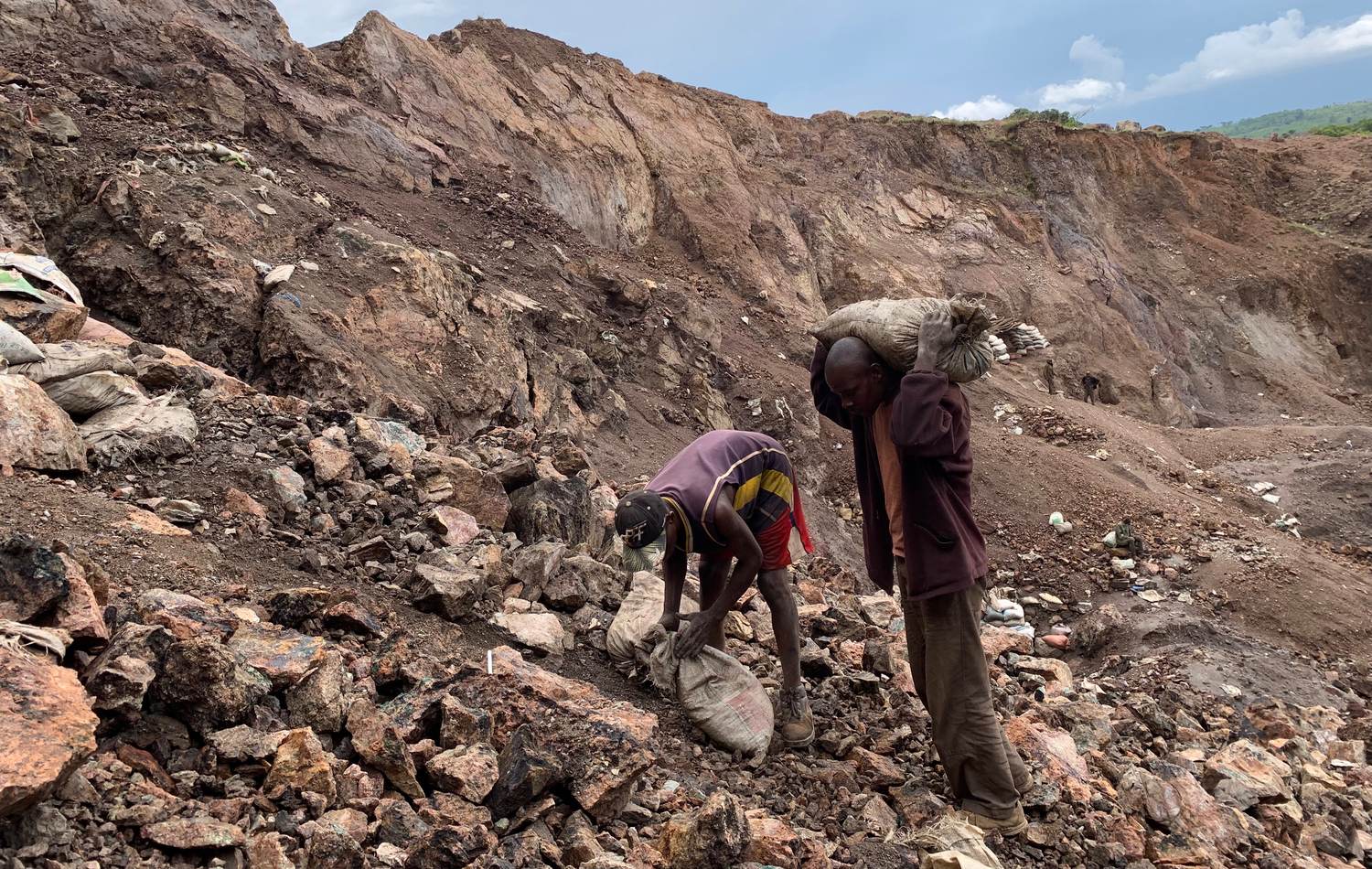
Cobalt is the battery age's most concentrated bet — and its most uncomfortable one. Nearly three quarters is dug in a single country, the Democratic Republic of the Congo, some of it by hand; most of it ships as bagged hydroxide to a single refiner, China; and since 2025 Kinshasa has rationed exports by decree to force the price up. This site tracks where cobalt is mined, refined and consumed, how an export ban rewired the market, and whether the EV industry escapes the metal before the DRC finishes cornering it — using open data from USGS, the Cobalt Institute, the IEA, BGS and price agencies.
0of cobalt content mined worldwide in 2025 — an all-time high (USGS)
0of world mine supply came from the DR Congo in 2025 (USGS)
0of the world's refined cobalt was produced in China in 2025 (Cobalt Institute)
0annual DRC export quota for 2026–27 — about half of 2024 exports (ARECOMS)
Interactive map
The cobalt world map
Mines and hydroxide plants, refineries, disrupted operations and development projects — from the Katanga Copperbelt to Indonesia's HPAL parks and the refinery towns of Finland, Canada and China. Tap a marker for details; toggle layers below. Circle size ≈ scale of operation.
Why Indonesia — the world's No. 2 cobalt producer (~44 kt in 2025, USGS) — has no cobalt mines on this map: its cobalt is a by-product of nickel. HPAL autoclaves on Obi Island and inside the Morowali and Weda Bay parks leach nickel laterite into mixed hydroxide (MHP) that carries the cobalt with it, so the markers there are plants rather than pits, and most of the cobalt leaves for Chinese refiners as MHP. Lygend's Obi line, which turns that hydroxide straight into battery-grade sulphate, is the country's first onshore cobalt refinery.
From ore to cathode to superalloy
One metal, two markets
Cobalt trades in a ladder of forms — ores nobody ships, intermediates priced as a percentage of a metal benchmark, battery salts measured in parts per million of impurity, and aerospace-certified metal that now commands its own premium. The tonnage lives in the battery chain; the strategy spans both. Tap a stage.
From a copper orebody in Katanga — or a nickel laterite in the Moluccas — to the cathode in a phone and the turbine blade in a jet. Almost nobody mines cobalt for its own sake: it rides along with copper and nickel, which is why supply ignores its price for years at a time.
← swipe →
Production & reserves
Where cobalt comes from
Mine production by country, 2025
Tonnes of cobalt content, log scale (USGS estimates)
Source: USGS Mineral Commodity Summaries 2026. World total ~310,000 t of cobalt content; 2025 figures are estimates. Indonesia's output has grown from ~1,300 t in 2015 to 44,000 t.
Reserves by country
Million tonnes of cobalt content (world total ~12 million tonnes)
Source: USGS Mineral Commodity Summaries 2026. Identified terrestrial resources are ~25 Mt; USGS estimates billions of tonnes more in seafloor polymetallic nodules.
The scissors: surging tonnage, whipsawing price
World mine production of cobalt (kt of cobalt content, left) vs the annual-average US spot cathode price ($/lb, right)
Sources: BGS World Mineral Statistics (production, cobalt content, 2018–2024); USGS MCS 2026 / S&P Global Platts (price, from 2021). Production nearly doubled between 2021 and 2024 — which is exactly why the price crashed to eight-year lows and Kinshasa reached for the export ban.
Explore where cobalt is mined vs where it is refined, country by country since 1970, on the supply-chain map.
Refining
The chokepoint is the refinery
The DRC digs the ore, but almost none of it becomes finished cobalt there: it leaves as hydroxide in bags and returns to the market as Chinese sulphate and metal. China refined about 79% of the world's cobalt in 2025 — a grip built on the battery boom, cheap capital and two decades of buying African mines.
Refining geography
A world of mines, one country of refineries — and a handful of exceptions
🇨🇳The sulphate machine
Zhejiang's refinery belt — Huayou in Quzhou and Tongxiang, GEM in Jingmen, and dozens more — turns Congolese hydroxide into battery-grade sulphate, chloride and metal. Huayou alone shipped ~46,500 t of cobalt products in 2025, roughly what the entire world outside China refined.
🇫🇮The Kokkola exception
The refinery hub at Kokkola, Finland — Umicore's cobalt-chemicals plant (permitted for 16,000 t/yr, applying for 21,000 t) alongside Jervois Finland's specialty lines — is the largest cobalt refining centre outside China, and an EU Critical Raw Materials Act strategic project.
🇮🇩The laterite shortcut
Indonesia now refines cobalt onshore: HPAL plants on Obi Island and in the Morowali and Weda Bay parks leach nickel laterites into mixed hydroxide, and Lygend's Obi complex converts it straight to battery-grade sulphate — a mine-to-salt chain China built outside China.
🚧The Western buildout
The rest of the map is small and struggling: Glencore's Nikkelverk in Norway and Sumitomo's Niihama in Japan refine modest tonnages; Sherritt's Fort Saskatchewan refinery halted in 2026 as its Cuban feed was choked; Vale's Long Harbour is ramping cobalt rounds; Electra's Ontario sulphate refinery — North America's first — targets commissioning from late 2026.
Sources: Cobalt Institute Cobalt Market Report 2025; company disclosures (Huayou 2025 annual report, Umicore, Jervois, Lygend/Harita, Glencore, Sumitomo, Sherritt, Vale Base Metals, Electra).
Where refined cobalt was produced, 2025
Share of world refined output — the step every cathode and superalloy passes through
Source: Cobalt Institute, Cobalt Market Report 2025 (refined production ~240,000 t in 2025, China 79%). The largest single facilities elsewhere are in Finland (Kokkola), Norway, Japan, Canada and, increasingly, Indonesia.
From ore to cell and to jet engine, step by step
The battery route (top) takes roughly three quarters of every tonne; the metal route (bottom) is smaller, older — and what defence planners lose sleep over. Scroll sideways on mobile →
Cobalt demand grew 13% in 2025 to about 276,000 tonnes — while the fastest-growing battery chemistry on Earth contains none of it. Both things are true: EVs, electronics and aerospace keep pulling demand up, and every price spike hands the cathode engineers a new reason to design cobalt out.
What cobalt is used for
Share of world demand by end use, 2024 (Cobalt Institute)
Source: Cobalt Institute, Cobalt Market Report 2024. "Other" includes magnets (Sm-Co, Alnico), tyre adhesives and biotech. In the US the picture inverts: superalloys take 51% of consumption (USGS, 2025).
The forces pulling in opposite directions
Demand grew 14% in 2024 and 13% in 2025 — despite LFP
🔋The LFP escape
Cobalt-free LFP took more than 55% of global EV battery deployments in 2025 — past nickel-based chemistries for the first time (IEA). In China it is ~81% of EV output. Every quota-driven price spike accelerates the exit.
📱The electronics floor
Phones, laptops and tablets still run on lithium cobalt oxide — the most cobalt-intensive cathode there is — and took ~30% of world demand in 2024. No LFP threat here: LCO's energy density per volume is unmatched for small devices.
✈️The aerospace pull
Superalloys for jet-engine hot sections are the fastest-tightening corner of the market: alloy-grade metal has traded at a sustained premium over standard grade since 2026 began, on commercial-aerospace backlogs and defence stockpiling.
~7%projected annual growth in cobalt demand to 2030 (Cobalt Institute / Benchmark), taking the market toward ~400,000 t — though the IEA has cut its long-term forecasts by more than 10% as LFP spreads.
Geopolitics
A glut, a ban and a quota machine
Cobalt spent the early 2020s drowning in its own supply: the biggest new mine in the metal's history ramped up just as Indonesia arrived and LFP took off. Then the country that mines three quarters of it decided to stop selling — and the market has been running on decrees ever since.
2022
The last boom
EV panic-buying drives cobalt to nearly $40/lb in the spring — then the wave breaks. CMOC's Kisanfu (KFM), the largest new cobalt mine ever built, begins ramping in the DRC; Indonesian HPAL plants start delivering nickel-cobalt MHP; and LFP's march through China's EV market gathers pace. The annual average is still $30.78/lb; it will halve within a year.
2023–2024
The glut
Supply nearly doubles in three years and the price caves: the LME average falls from $23/lb in 2021 to $11.84 in 2024, an eight-year low. Jervois suspends its brand-new Idaho mine — the only primary cobalt mine in America — weeks after opening it. CMOC produces 31% above nameplate; hydroxide payability sinks toward 60% of an already-depressed metal price.
22 Feb 2025
Kinshasa pulls the plug
With standard-grade cobalt at a nine-year low near $10/lb, the DRC's new strategic-minerals regulator ARECOMS suspends all cobalt exports — industrial and artisanal — for four months, and a decree the same week confirms state-owned EGC's monopoly over artisanal cobalt. CMOC's trading arm IXM declares force majeure; the ban is extended in June. Prices jump within days.
16 Oct 2025
Quotas replace the ban
ARECOMS Decision 004/2025 swaps the ban for export quotas: 18,125 t for the rest of 2025, then 96,600 t a year for 2026 and 2027 — 87,000 t shared pro-rata among producers plus a 9,600 t state "strategic quota" — roughly half of what the DRC exported in 2024. The LME price clears $47,000/t within weeks, a 32-month high. Over 2025, hydroxide gains ~328%, metal ~130%.
Aug–Dec 2025
Washington deals in
The Pentagon's logistics agency issues its first cobalt purchase tender since 1990 — 7,480 t of alloy-grade metal over five years — then cancels it before year-end. A Section 232 investigation covers processed cobalt. And on 4 December, alongside the DRC–Rwanda peace accords, Washington and Kinshasa sign a Strategic Partnership Agreement sketching a US-backed strategic mineral reserve — cobalt included.
Feb 2026
The Orion MoU — and two supply hits
Glencore signs a non-binding MoU to sell 40% of its Congolese crown jewels — KCC and Mutanda — to the US-backed Orion Critical Mineral Consortium at a $9 billion enterprise value, staying on as operator. The same month, Cyclone Gezani shuts Madagascar's Ambatovy plant and Cuba's fuel crisis puts Sherritt's Moa operations on standby: the ex-DRC supply map is thinning too.
Mar–Jul 2026
The quota machine grinds
Exports run far below quota — paperwork, port testing, a collapsed bridge on the Zambian corridor — and hydroxide peaks near $26/lb in April with payability touching 100% of the metal price. In June ARECOMS rules that unused quotas are forfeited to the state's new strategic stockpile, scrapping an estimated 15,000–20,000 t; in July a missed customs notification stalls exports for days. One regulator is now the market's single point of failure.
Aug 2026
Reality check
CMOC reports a record first half — 65,305 t of cobalt, twice its annual export quota — and record profits, stockpiling the excess in-country. Prices drift lower on weak Chinese battery demand (hydroxide $22–23/lb, metal ~$25/lb); ARECOMS floats cutting the quotas further; Jinchuan and MMG lobby for bigger shares; and a reported $100M US grant revives talk of restarting Idaho. The decree economy rolls on.
Sources: ARECOMS decisions via IEA policy database; Fastmarkets; Benchmark Mineral Intelligence; Glencore FY2025 production report; CMOC disclosures; US State Department; USGS MCS 2026; Semafor; Reuters.
Trade & prices
A market priced in three currencies
Cobalt has an LME contract almost nobody uses: the real market runs on Fastmarkets' Rotterdam metal assessment, on hydroxide "payability" — a negotiated percentage of that metal price — and on Chinese sulphate quotes in yuan. The flows are simple: Congolese hydroxide goes east to China, refined cobalt comes west to everyone else.
US cobalt import sources
Metal, oxide and salts, average 2021–2024 — refiners, not miners: the DRC dependency hides one step upstream
Source: USGS MCS 2026. US net import reliance was 79% of consumption in 2025 — with one small cobalt-bearing mine (Eagle, Michigan) whose concentrate is exported for processing. Norway, Finland, Canada and Japan refine; the ore behind them is largely Congolese and Cuban.
The whipsaw, in annual averages
US spot cathode price, $/lb (annual average)
Source: USGS MCS 2026 (S&P Global Platts). The 2025 bar hides the ride: a nine-year low near $10/lb in February, then a surge after the export ban. By August 2026 standard-grade metal sat around $25/lb — up ~160% from the pre-ban low.
Three prices, one metal
What you pay depends on which rung of the ladder you stand on
The metal price
Standard-grade cobalt — 99.8% broken cathode, cut cathode and briquettes — is assessed in-warehouse Rotterdam (Fastmarkets) with an LME contract alongside. Since 2026, aerospace-certified alloy-grade metal has held a sustained premium over standard grade for the first time — the superalloy market outbidding the battery market.
The hydroxide payability
DRC hydroxide — the intermediate that feeds China — is priced as a negotiated percentage of the metal benchmark. In the glut it sank toward 60%; in the 2026 squeeze it touched 100% — an intermediate briefly worth as much as finished metal, the purest measure of how badly refiners needed feed.
The sulphate quote
Battery-grade cobalt sulphate (20.5% Co) trades in yuan inside China — 70,000–76,000 yuan/t in August 2026 — and sets the economics of every NMC precursor plant. Recycled cobalt re-entering the market via black mass increasingly caps it.
The stockpile shadow
The strangest feature of the quota era: the price-setting tonnage sits in warehouses inside the DRC. CMOC alone produced twice its export quota in H1 2026; Kinshasa's new Gécamines-managed strategic stockpile absorbs forfeited quota. When and how that metal is released now moves the market as much as any mine.
The fastest-changing corner of the supply map — and the DRC's dilemma
Indonesia mined ~44,000 t of cobalt in 2025 (USGS; some analysts put it near 49,000 t), up from ~1,300 t a decade ago — all of it a by-product of the nickel-laterite HPAL plants Chinese groups built on Obi Island, at Morowali and at Weda Bay. Jakarta needs no cobalt policy: its nickel ore quotas (RKAB) indirectly cap output. Kinshasa announced a market-management partnership with Jakarta in March 2025, but no OPEC-style mechanism exists — and every tonne of quota the DRC withholds is market share Indonesia inherits. Benchmark sees Indonesia at ~20% of world supply by 2030; the IEA expects it to overtake the DRC by 2040.
~14%of world mine supply came from Indonesia in 2025 (USGS) — the only serious geological alternative to the DRC, and it answers to the same Chinese refiners.
What the OECD's 2026 regional review of African critical minerals adds. Its production shares are for 2024 (USGS Mineral Commodity Summaries 2025 basis), a year behind the charts above; its 2040 figures are the authors' calculations from the IEA Critical Minerals Data Explorer.
🛑A price lever, not a processing policy
Of the seven African raw-mineral export bans, enacted or planned, that the OECD lists, the DRC's is the only one aimed mainly at lifting prices rather than forcing local processing — an option open only to a country that mined about 76% of the world's cobalt in 2024. Prices more than doubled between February and October 2025. The paper warns that the quota regime replacing the ban invites discretionary allocation, rent-seeking and smuggling.
🇨🇳Chinese stakes, Congolese ore
Chinese entities own or hold stakes in 29 of the roughly 40 active copper-cobalt properties in the DRC. Of the 79 African mines with at least 10% Chinese ownership in 2022, 30 were Congolese, and 35 of the 38 in the DRC and Zambia produce copper, cobalt or both (Landry, 2025). Chinese firms rank only fifth in African mine ownership overall, behind US, Australian, Canadian and British companies: their weight is concentrated, not continent-wide.
🏭Refining stays offshore
On IEA-based projections, no African country contributes significantly to cobalt refining now or by 2040 — Zambia's Chambishi refinery (on the map) has been largely idle since 2020. The OECD adds a caution about the US-backed Lobito Corridor to Angola's Atlantic coast: corridors take years and complex financing, and risk delivering more efficient extraction rather than industrial development.
⛏Formalising the diggers
The OECD counts EGC's first 1,000 t of traceable artisanal cobalt (November 2025) as a key formalisation step, but notes that most past formalisation drives failed because the costs to miners outweighed the benefits (World Bank, 2024). Its recommendation to buyers: proportionate, risk-based traceability that lets artisanal producers into formal chains, since excluding them pushes trade into less transparent channels.
China mines less than 1% of the world's cobalt on its own territory — and controls the market anyway. Chinese companies own most of the DRC's industrial mines and nearly all of Indonesia's HPAL plants, and Chinese refineries turn their output into the sulphate and metal everyone else buys.
~79%
of the world's refined cobalt was produced in China in 2025 (Cobalt Institute). Its share along the mine-to-battery chain:
Sources: USGS MCS 2026 (mine production); Chinese-controlled share of DRC output ~70–80% (Benchmark and industry estimates — CMOC alone mined over half of the DRC's 2025 total); Cobalt Institute Cobalt Market Report 2025 (refined share 79%).
Dual use
The original strategic metal
Long before batteries, cobalt was the metal of the jet age: no other element keeps a turbine blade solid at combustion temperatures. It triggered one of the great commodity panics of the Cold War, and it is back on every defence-procurement list — this time with the battery market bidding against the arsenal.
✈️Superalloys
Cobalt-bearing superalloys form the hot sections of jet engines and gas turbines — blades, vanes, combustors — where nothing else survives above ~1,000°C. Superalloys take 51% of US cobalt consumption (USGS), and USGS notes substitution generally costs performance. Every fighter, airliner and power turbine carries it.
🎯Magnets & munitions
Samarium-cobalt magnets hold their field at temperatures that demagnetise neodymium — which puts them in missile guidance, radar, satellites and electronic warfare. Tungsten-carbide with a cobalt binder is the hard edge of armour-piercing penetrators and nearly every machine tool that makes weapons.
💥1978: the cobalt crisis
In May 1978 Katangese rebels seized Kolwezi — then, as now, the heart of world cobalt — and French and Belgian paratroopers retook it. Amid fears of a Soviet squeeze, cobalt went from $5.62/lb in 1977 to $32.83 by 1979, a near-sixfold panic that taught the Pentagon to stockpile it. The mines at the centre of that war are the same ones under quota today.
📦The empty stockpile
The US National Defense Stockpile sold down its Cold-War cobalt decades ago; today its plan lists only samarium-cobalt alloy feed. In August 2025 the DLA issued its first cobalt tender since 1990 — 7,480 t of alloy-grade metal over five years — then cancelled it within months, even as Congress handed the Pentagon ~$7.5B for critical-minerals stockpiling. Rebuilding a reserve at quota-era prices is proving harder than announcing one.
🏭Money for the missing middle
Defense Production Act Title III money is flowing to the gap where US refining should be: $20M to Electra's Ontario sulphate refinery, $6.4M to Fortune Minerals' Alberta project, $15M to Jervois' Idaho drilling — and, reportedly, a $100M grant in August 2026 toward an Idaho cobalt refinery that could finally restart America's only primary cobalt mine.
🏛Critical by every list
Cobalt sits on the US, EU (critical and strategic), Japanese and Indian lists; JOGMEC stockpiles it toward a 60-day consumption target; ten of the EU's first CRMA strategic projects involve cobalt. A US Section 232 probe found in January 2026 that processed-cobalt imports threaten national security — holding tariffs in reserve while Washington negotiates.
Sources: USGS MCS 2026; DLA solicitations via Stars and Stripes and USGS; DPA Title III awards (DoD); Federal Register / Covington (Section 232); EU Critical Raw Materials Act; US Army Combat Studies Institute (Shaba II); historical price series.
Capital flows
Where the cobalt money is going
For years cobalt attracted capital only by accident — it came along with the copper and nickel investments. The quota era changed the question: the money now chases refining capacity outside China, equity in the DRC's mines, and the stockpiles themselves. Presented as observation, not investment advice.
🇺🇸The Orion gambit
The US-backed Orion Critical Mineral Consortium's non-binding MoU for 40% of Glencore's KCC and Mutanda — at a $9B enterprise value, with rights to direct sales to nominated buyers — is the biggest Western move on cobalt in decades, nested inside the December 2025 US–DRC Strategic Partnership and its planned mineral reserve.
🇨🇳CMOC doubles down
The world's No. 1 producer answered the quotas by investing more: $1.08B for KFM Phase 2 (completion 2027), record H1 2026 profits, and an unbroken 100,000–120,000 t production plan — stockpiling what it cannot export and betting Kinshasa eventually has to let the metal out.
🇮🇩The HPAL wave
Indonesian nickel-cobalt keeps absorbing billions: GEM's $8B Morowali recycling-and-nickel hub plan, Huayou and Vale Indonesia's Sorowako HPAL, QMB's next line starting late 2026, and a sovereign-wealth deal with Danantara. Cobalt is the by-product that makes the nickel maths work — and vice versa.
🏗The Western refinery bet
Electra's Ontario refinery is finally funded ($82M against a $73M budget, commissioning from late 2026); Managem switched Bou Azzer's whole output to battery sulphate in January 2026; Cobalt Blue targets FID on its Broken Hill–Kwinana chain; Kokkola expands under EU strategic-project status. Small tonnages — but the only non-Chinese growth there is.
🏦States as buyers
Governments have become the marginal bid: the DRC's own strategic stockpile absorbs forfeited quota, Washington's DLA tendered (then cancelled) a five-year purchase, Saudi Arabia's Manara holds 10% of Vale Base Metals, and Japan's JOGMEC quietly stockpiles toward its 60-day target. In a rationed market, reserves are policy.
⚠️The risks
Every one is structural: LFP can keep eating the demand base the quotas defend; ARECOMS is a single point of failure that has already stalled exports twice; Indonesia inherits whatever share the DRC withholds; DRC in-country stockpiles hang over any rally; and artisanal-supply-chain exposure remains a reputational tripwire for every buyer.
This section describes where capital is flowing, based on public data. It is not financial advice.
Sources: company and government disclosures (Glencore, CMOC, GEM, Huayou, Electra, Managem, Cobalt Blue, Vale Base Metals); US State Department; Fastmarkets; Semafor; Benchmark Mineral Intelligence.
Company tracker
The companies that move cobalt
Miners, refiners and developers across the chain. One Chinese company mines more than a third of world supply; one Swiss trader-miner sits on the Western share; a state monopoly buys the artisanal tonnes; and a handful of developers are trying to build the missing Western middle. Filter by segment or search.
Company
Segment
Key assets
Status & recent signals
Company status reflects public disclosures as of August 2026. This is an observational tracker, not investment advice.
USGS Mineral Commodity Summaries 2026 — Cobalt — world mine production, reserves and resources, US trade, prices, stockpile and end-use notes. 2025 figures are estimates; production is cobalt content.
Cobalt Institute — Cobalt Market Report 2025 (prepared by Benchmark Mineral Intelligence) — demand by end use, refined production and China's 79% share, recycling share, market balance.
Prices — USGS-published annual averages (S&P Global Platts US spot cathode; LME cash); Fastmarkets standard-grade and hydroxide assessments via trade press; LME cobalt; SMM/Mysteel Chinese sulphate quotes.
DRC export controls — ARECOMS suspension and Decision 004/2025 via the IEA policy database and Fastmarkets/Benchmark reporting; US–DRC Strategic Partnership Agreement via the US State Department.
Artisanal mining — Fair Cobalt Alliance impact reporting; Amnesty International / IBGDH investigations of evictions and abuses around industrial mines; EGC announcements via trade press.
OECD (2026), Critical minerals in Africa: a regional overview — OECD Global Relations Policy Papers 2026/7, authored by a European Council on Foreign Relations team (CC BY 4.0): Africa's share of cobalt production, reserves and ownership, IEA-based projections to 2040, African export bans, quotas and levies, and the policy findings in the "Africa view" card. Its production shares are 2024 figures (USGS MCS 2025 basis); this page keeps the newer USGS MCS 2026 numbers.
Notes — mine and plant coordinates are approximate. Tonnages are cobalt content unless stated. Hydroxide is priced as a payable percentage of the standard-grade metal price. Refining shares are Cobalt Institute/Benchmark estimates. Last data refresh: August 2026. Header photo: artisanal cobalt miners in the DRC — IIED via Wikimedia Commons, CC BY 2.5.
FAQ
Common questions
What is cobalt used for?
Batteries dominate: about 43% of the world's cobalt goes into EV batteries and another 30% into the lithium-ion cells of phones, laptops and power tools (Cobalt Institute, 2024). The rest is the older, strategic market — superalloys for jet-engine hot sections (about half of US consumption), tungsten-carbide cutting tools, catalysts, samarium-cobalt magnets and the pigment that has coloured ceramics cobalt-blue for a thousand years. Total demand grew 13% in 2025 despite the rise of cobalt-free battery chemistries.
Which country produces the most cobalt?
The Democratic Republic of the Congo mined about 230,000 of the world's 310,000 tonnes of cobalt in 2025 (USGS) — roughly 73%, almost all of it as a by-product of copper from the Katanga Copperbelt, and a share of it dug by hand. Indonesia is now a clear second at about 44,000 tonnes, a by-product of its nickel boom, up from almost nothing a decade ago. But the tightest grip is downstream: China refined about 79% of the world's cobalt in 2025 (Cobalt Institute).
Why did the DRC ban cobalt exports, and what are the quotas?
By early 2025 cobalt had crashed to eight-year lows around $10 per pound under a wall of new supply. On 22 February 2025 the DRC — supplier of three quarters of the world's cobalt — banned exports outright, and from 16 October 2025 replaced the ban with quotas run by the regulator ARECOMS: 18,125 tonnes for the rest of 2025, then 96,600 tonnes a year for 2026 and 2027, including 9,600 tonnes reserved for the state — roughly half of what the country exported in 2024. Prices responded violently: hydroxide rose about 300% over 2025, and standard-grade metal traded near $26 per pound in August 2026. Cobalt is a strategic substance under the DRC's 2018 Decree 18/042, alongside coltan and germanium, which is what places its exports under ARECOMS.
Is the world running out of cobalt?
No. USGS puts reserves at about 12 million tonnes — roughly forty years at the 2025 mining rate — with identified terrestrial resources of about 25 million tonnes, and it estimates billions of tonnes more in seafloor polymetallic nodules. The risk is not geology but structure: three quarters of mine supply comes from one country, four fifths of refining happens in another, and the export rules can change with a decree.
Can batteries go cobalt-free?
Increasingly, yes — and it is the biggest force reshaping this market. Cobalt-free LFP chemistry took more than 55% of global EV battery deployments in 2025 (IEA), overtaking nickel-based cells for the first time, and high-nickel NMC keeps thrifting cobalt out of the rest. Yet total cobalt demand still grew 13% in 2025: EV volumes, consumer electronics (whose LCO cathodes are the most cobalt-rich of all) and aerospace superalloys outweigh the substitution — for now. Forecasters see roughly 5–7% annual demand growth to 2030, at the mercy of chemistry choices made in Asia's battery labs.
What about artisanal mining and child labour?
Between about 150,000 and 250,000 people dig cobalt by hand in the DRC's artisanal sector, historically supplying anywhere from a few percent to a fifth of national output depending on prices — with documented child labour and fatal accidents. Since February 2025 the state's Entreprise Générale du Cobalt has held a legal monopoly on buying and exporting artisanal cobalt, and it produced its first fully traceable cathodes in November 2025. Formalisation remains partial: initiatives such as the Fair Cobalt Alliance work on mine-site safety and school enrolment, while Amnesty International continues to document evictions and abuses around industrial mines. Across sub-Saharan Africa at least 10 million people work in artisanal and small-scale mining, and some 60 million more depend on it (World Bank figures cited by the OECD, 2026).
Need a deep-dive report on cobalt?
That's exactly what we do. We produce commissioned deep-dive reports on cobalt, covering angles such as mine-to-refinery supply-chain mapping, the DRC quota regime and its politics, Indonesia's HPAL wave, China's refining grip, battery-chemistry scenarios and what they mean for demand, artisanal-mining due diligence and the Western refinery buildout. Every report is source-cited — charts, maps and citations included — and built on the same open, verified data behind this dashboard. Email hello@mineral.watch with a short note on what you need and we'll come back with a scoped proposal.
Custom research
Need an ad hoc data-driven research report?
We produce bespoke, source-cited research on cobalt and other strategic minerals — supply-chain mapping, trade-flow analysis, country and commodity deep-dives — built on the same open data behind this dashboard.
mineral.watch is an independent data hub, and it grows with the people who use it. Introduce yourself and we'll let you know when the cobalt figures on this dashboard are updated and when new dashboards, datasets and research go live — no noise, just what's new.
Telling us your sector and organisation helps too: it shows us who relies on this data — analysts, policymakers, journalists, researchers — and shapes what we build next, from new minerals to custom research.
Prefer to talk directly? Corrections, data tips and collaboration ideas are always welcome at hello@mineral.watch.