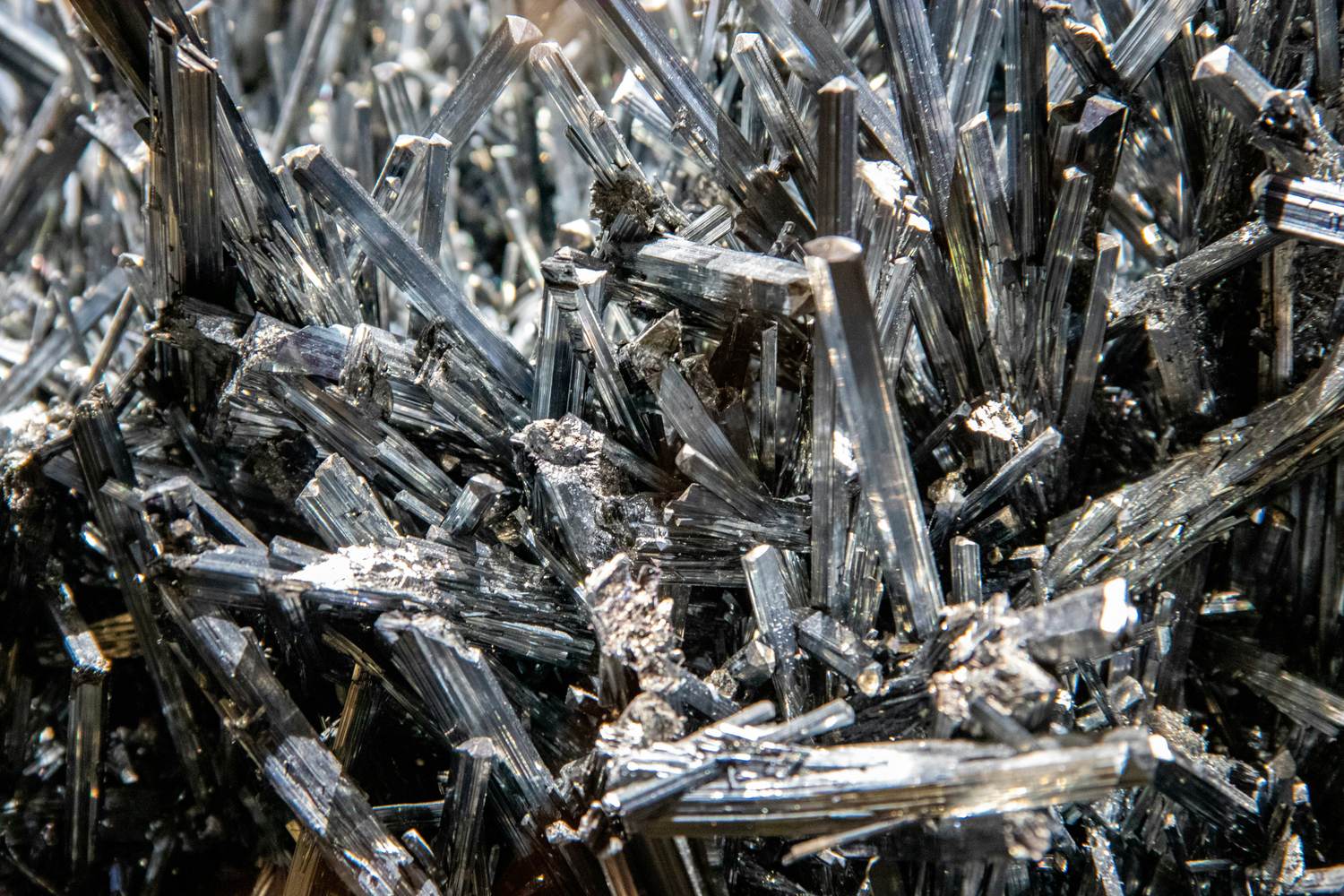
Antimony is the smallest market on any critical-minerals list — and the first one to blow up. A brittle, silvery metalloid, it keeps aircraft seats and circuit boards from burning, hardens the lead in every bullet and battery grid, and clarifies the glass on solar panels. China mines more of it than anyone, smelts far more, and in 2024 turned that grip into a weapon: export licences in September, then an outright ban on sales to the United States in December. Prices roughly quintupled. This site tracks where antimony is mined, roasted and consumed, how a metal most people can't name became a superpower bargaining chip, and the West's scramble to rebuild a supply chain it let rust for thirty years — using open data from USGS, BGS, trade statistics and price agencies.
0of antimony mined worldwide in 2025 — roughly a third less than in 2020 (USGS via trade press)
0of world mine supply came from China, Russia and Tajikistan in 2025 (USGS-derived estimates)
0price multiple from early 2024 to the spring-2025 peak near $60,000/t Rotterdam (price-agency assessments)
0EXIM loan approved in May 2026 to reopen America's WWII antimony district at Stibnite, Idaho (EXIM/Perpetua)
Interactive map
The antimony world map
Mines and gold-antimony operations, roasters and smelters, idled assets and the development wave — from the Hunan veins that armed two world wars to the Idaho project the Pentagon is paying to reopen. Tap a marker for details; toggle layers below. Circle size ≈ scale of operation.
Antimony rarely trades as shiny metal: it moves as sulphide concentrate, as the white trioxide powder blended into plastics, as an invisible hardener inside lead, and as a military-spec sulphide that ignites primers. Each form has its own buyers, its own price — and, since 2024, its own export-control code. Tap a stage.
From a stibnite vein in Hunan — or a gold mine in Siberia, Victoria or Idaho — to the circuit board that doesn't catch fire and the cartridge that does. Increasingly, antimony arrives as a passenger in gold ore: the gold pays for the mine, and the antimony comes along as strategic freight.
← swipe →
Production & reserves
Where antimony comes from
Mine production by country, 2025
Tonnes of antimony content, log scale (USGS estimates via trade press)
Source: USGS Mineral Commodity Summaries via trade-press compilations (2025 figures are estimates). World total ~110,000 t. China's output has halved since the mid-2010s as Xikuangshan and the Guangxi belt age and environmental inspections bite.
Reserves by country
Thousand tonnes of antimony content (world total ~2 million tonnes)
Source: USGS Mineral Commodity Summaries. One of the thinnest reserve cushions of any strategic mineral — under two decades at current mining rates, and much of it in China, Russia and Bolivia.
The shrinking base: a market that was tightening before the ban
World mine production of antimony, tonnes of metal content (BGS, 1970-style long series shown 2018–2024)
Source: BGS World Mineral Statistics (production, antimony content, 2018–2024). Output fell roughly 40% between 2018 and 2024 — China's environmental crackdowns, ore depletion and falling grades — which is exactly why the 2024 export controls hit a market with no slack.
Explore where antimony is mined, country by country since 1970, on the supply-chain map.
Smelting
The chokepoint is the roaster
Mining antimony is the easy half. Turning stibnite concentrate into the trioxide that goes into plastics — or the 99.65% metal ingot the market prices — happens in roasters and reduction furnaces that the West spent decades closing. China dominates that middle step, which is why even non-Chinese concentrate has usually had to pass through Chinese hands.
Smelting geography
One Chinese valley, a handful of exceptions — and a rebuild measured in single-digit thousands of tonnes
🇨🇳The Lengshuijiang machine
Xikuangshan in Hunan — "the world's antimony capital", mined since 1897 — anchors a smelting complex (Hsikwangshan Twinkling Star, under China Minmetals) rated at ~30,000 t/yr of refined antimony and ~40,000 t/yr of antimony products, exporting to 50+ countries. Guangxi and Yunnan host the rest of a belt that processes imported ore, too.
🇴🇲The idle exception
SPMP's roaster in Oman's Sohar Free Zone — built for ~20,000 t/yr of antimony plus by-product gold, precisely to break the Chinese tolling monopoly — has sat idle since early 2024 for want of concentrate, and as of August 2026 is looking for a buyer or operating partner. The West's spare smelting capacity exists; it just has nothing to feed it.
🇺🇸Two smelters, no mine
United States Antimony runs the only operating smelter in the US at Thompson Falls, Montana — mid-expansion toward 300–400 tons a month — plus the restarted Madero smelter in Mexico. Until Perpetua's Stibnite mine arrives, they run on imported and purchased feed: America can smelt antimony, it just doesn't mine any.
🇦🇺The by-product route
Nyrstar's Port Pirie lead smelter in South Australia poured its first antimony metal in November 2025 and is ramping toward 2,000 t/yr (potentially 5,000 t by 2028) — recovered from the lead circuit, backed by A$105M in government support, and Australia's only source of finished antimony metal.
Sources: company profiles and disclosures (Hsikwangshan Twinkling Star, SPMP via Metalnomist, United States Antimony, Nyrstar); Asian Metal; InDaily; ABC News; trade press. Capacities are nameplate.
Where the middle of the chain sits
Approximate shares of the smelting and processing step — the stage every flame retardant and ingot passes through
Source: industry and government estimates via trade press (China's share of antimony smelting and trioxide output is commonly put at up to ~80%; Australia's 2026 strategic-reserve announcement cited China and Russia together controlling ~80% of supply). Precise smelting statistics are not published — itself a symptom of how concentrated the market is.
From stibnite to synergist and to ingot, step by step
The oxide route (top) carries most of the tonnage into plastics; the metal route (bottom) feeds batteries, bearings — and ammunition. Scroll sideways on mobile →
ATO = antimony trioxide. The military-spec branch — antimony trisulfide for primers (MIL-A-22131, min 70% Sb) — is small in tonnage and outsized in strategic weight; the US Army opened a pilot plant for it with Perpetua and Idaho National Laboratory in July 2026.
Demand
The fireproofing metal with a battery habit
Antimony demand is unglamorous and stubborn: fire-safety rules don't relax when prices quintuple, cars still need lead-acid batteries to start, and every new solar panel needs clarified glass. That inelasticity is precisely what made the market such an effective pressure point.
What antimony is used for
Approximate share of world demand by end use (industry estimates)
Source: industry and USGS end-use estimates via trade press; shares are approximate and vary by year. In the US, flame retardants alone account for roughly 40% of reported consumption (USGS).
The forces pulling demand
Slow-growing, hard to substitute — with one fast-growing exception
🔥The synergist lock-in
Antimony trioxide makes halogenated flame retardants work — in circuit boards, cable sheathing, vehicle seats, aircraft interiors and building plastics. Fire-safety codes wrote it into the modern world, and USGS notes substitutes generally cost performance. Demand moves with regulation, not price.
☀️The solar wildcard
Sodium antimonate fines and clarifies the high-transmittance glass on photovoltaic panels. Solar glass was the fastest-growing antimony use of the 2020s — one reason China, the world's solar factory, became a net importer of antimony ore even while restricting exports of the processed forms.
🔋The lead-acid floor
Antimonial lead stiffens the grids in lead-acid batteries — still the battery that starts nearly every combustion car, backs up telecom towers and powers forklifts. It is also antimony's circular loop: recycled battery lead returns much of its antimony to the pool, the closest thing the West has to domestic supply.
>100 ktof annual world consumption against ~110 kt of mine supply and a thin scrap stream — a structurally tight market even before export controls, which is why inventories, not mines, set the price in 2024–25.
Geopolitics
A ban, a spike and a scramble
Antimony was the test shot of the critical-minerals trade war: the first metal China banned outright for one named country. The sequence — licence, ban, spike, truce — is now the template every other export-controlled mineral is read against.
2018–2023
The quiet depletion
World mine output slides from ~174,000 t to ~118,000 t (BGS) as China's flagship deposits age: Xikuangshan's grades fall, environmental inspections idle Hunan and Guangxi operations, and Chinese smelters begin importing ore from Myanmar, Tajikistan and Russia to stay fed. Rotterdam drifts around $11,000–13,000/t — cheap enough that nobody in the West notices the floor thinning.
15 Aug 2024
Beijing reaches for the lever
China announces dual-use export controls on antimony — ores, oxides, metal, hydrides and smelting technology — effective 15 September, citing national security. It is the third strike after gallium/germanium (2023) and graphite: every licence now passes through MOFCOM. Rotterdam, already at records near $25,000/t on the shrinking supply base, keeps climbing as buyers panic-order ahead of the deadline.
3 Dec 2024
The ban
Responding to new US chip sanctions, China bans exports of antimony, gallium and germanium to the United States outright — the first time it names a single country. US imports from China, 63% of American supply in recent years, collapse ~97% between August and December. The Rotterdam price ends the year around $39,000–40,000/t, roughly triple January's level.
H1 2025
The $60,000 tonne
Rotterdam grinds up to roughly $60,000/t by late spring (~$27.50/lb in the US market, per trade-press assessments) while China's domestic price lags tens of thousands of dollars below — a spread that makes a tonne of antimony worth smuggling. Reuters documents surging "Thai" and "Mexican" antimony flows into the US; Beijing answers with a May transshipment crackdown. Inside China, the squeeze is real too: by June, 45% of surveyed smelters are at zero output for want of ore.
Sep–Oct 2025
America breaks ground
The rebuild stops being a slide deck: Perpetua gets its Forest Service notice to proceed (19 Sep) and breaks ground at Stibnite (21 Oct) after posting $139M in financial assurance; Nova Minerals wins a $43.4M Pentagon award for Alaskan antimony (2 Oct); US Antimony lands a ~$245M sole-source DLA contract to restock the National Defense Stockpile — then bids ~A$720M for Australia's Larvotto and is rebuffed within a week.
9–10 Nov 2025
The truce
After the Trump–Xi meeting, Beijing suspends the US-specific ban on antimony, gallium and germanium until 27 November 2026 — a suspension, not a repeal, with the September 2024 licensing regime still standing for every buyer. Days later, Nyrstar pours Australia's first antimony metal at Port Pirie. The price eases off its highs but settles at multiples of the pre-control level.
Jan–Apr 2026
Allies start stockpiling
Australia unveils a A$1.2B Critical Minerals Strategic Reserve with antimony explicitly prioritised (12 Jan), including A$185M for physical stockpiles. Talco Gold's 20,000 t/yr smelter in Tajikistan — a TALCO–Tibet Huayu joint venture — nears completion; Kyrgyzstan begins a phased relaunch of the Soviet-era Kadamjay combine; Alkane signs an earn-in over Nagambie, Australia's highest-grade resource.
May–Aug 2026
The rebuild gets real — and expensive
EXIM's board approves a $2.9B, 13-year loan for Stibnite (21 May) — the bank's fourth-largest ever — and courts wave construction on (injunction denied 29 May, stay denied 17 June, appeals still running). The US Army and Idaho National Laboratory cut the ribbon on a military-spec antimony trisulfide pilot plant (29 Jul). In New South Wales, Larvotto's Hillgrove starts commissioning (21 Jul) with first production due within days as August ends. Not everything goes the West's way: Slovakia cancels the licence over the EU's largest antimony resource (May), Oman's idle roaster goes up for sale (Aug) — and prices ease to $25,000–31,000/t by mid-2026, still roughly double the pre-control level.
Sources: China MOFCOM announcements via Reuters and Exiger; USGS; BGS; Reuters transshipment investigation; SMM smelter surveys via trade press; Perpetua Resources, EXIM, US Army/INL, DLA, Nova Minerals, US Antimony, Larvotto, Alkane, Nyrstar and Australian-government disclosures.
Trade & prices
A market repriced by decree
Antimony has no exchange contract: the market runs on price-agency assessments — Rotterdam in dollars, China in yuan — and on bilateral deals for concentrate. Since 2024 the defining feature has been the spread: what a tonne is worth inside China versus what the cut-off West will pay for it.
US antimony import sources
Metal and oxide, recent multi-year average — the dependency the ban weaponised
Source: USGS Mineral Commodity Summaries (import shares, metal and oxide). US net import reliance is ~85% of consumption, with most of the remainder covered by recycled antimonial lead — and no domestic mine production since 2016.
Source: trade-press price compilations of Fastmarkets/Argus-type assessments (approximate). From ~$6/lb in early 2024 to ~$27.50/lb at the spring-2025 peak — Rotterdam metal near $60,000/t — before the November 2025 truce and new supply let air out: ~$25,000–31,000/t by June 2026, still about double the pre-control level.
How this market actually trades
Four prices, one metalloid
The Rotterdam benchmark
Regulus-grade 99.65% antimony metal, assessed in-warehouse Rotterdam by the price agencies, is the number contracts reference. No LME contract, thin liquidity, few sellers: when the ban hit, the "price" was whatever the last desperate trade printed — which is how a sleepy metal quintupled.
The China discount
Inside China the same metal trades in yuan at a persistent discount to Rotterdam — at the 2025 extreme, less than half the Western price. That spread is the export-control premium made visible, and it hands a windfall to anyone who can move metal across the line: legally with a licence, or otherwise.
The concentrate squeeze
Mines sell 45–60% concentrate to smelters at a payable percentage of the metal price. With Chinese smelters short of ore — 45% of them at zero output in mid-2025 — payables rose even as Beijing restricted what could leave. New non-Chinese supply (Hillgrove, Stibnite) is contracted years ahead: Wogen took Larvotto's first seven years.
The laundering routes
Trade data tells the enforcement story: after December 2024, US imports "from Thailand" and "from Mexico" surged past historical totals while direct Chinese flows died — classic transshipment, documented by Reuters and answered by Beijing's May 2025 crackdown. Vietnam, which mines ~220 t a year, became the No. 2 supplier of antimony metal to the US. Every spread this wide builds its own pipeline.
Sources: Fastmarkets/Argus assessments via trade press; Reuters (July 2025 transshipment investigation); SMM smelter surveys; company offtake disclosures.
The quiet riser: Tajikistan
The other supply story — and its own dependency question
Tajikistan mined ~22,000 t of antimony in 2025 — a fifth of world supply, up from ~11,000 t a decade ago — from the US-owned Anzob combine (Comsup Commodities, >$300M invested) and the Talco Gold joint venture at Konchoch. It now supplies ~42% of the EU's antimony imports. But the fastest-growing processing capacity there is the new 20,000 t/yr Talco Gold smelter — a 50/50 venture with China's Tibet Huayu Mining. Even the diversification story has a Chinese partner.
~20%of world mine supply came from Tajikistan in 2025 (USGS-derived estimates) — the largest non-sanctioned, non-Chinese source, sitting between Russia, Afghanistan and China.
Sources: USGS-derived estimates via trade press; SpecialEurasia; Avesta/Asia-Plus (Talco Gold smelter); company statements.
Concentration risk
The China chokepoint
China's mine share has actually fallen — from three-quarters of world output in the mid-2010s to under 40% as its deposits age. Its leverage never did: the smelting, the trioxide plants, the price discovery and the export rules all still run through Beijing, and imported ore from Myanmar, Russia and Central Asia keeps the furnaces fed.
~80%
of the world's antimony smelting and processing is commonly attributed to China (industry and government estimates). Its share along the chain:
Sources: USGS-derived production estimates via trade press (mine share); industry/government processing estimates cited by, among others, Australia's strategic-reserve announcement (China + Russia ~80% of supply); USGS import statistics (63% of US metal-and-oxide imports before the ban).
Dual use
The ammunition metal
Antimony's military résumé is older than the periodic table — kohl in pharaohs' eyeliner, Gutenberg's type metal, shrapnel hardener in two world wars. Almost every conventional round fired today contains it three times over: in the hardened lead, in the primer, in the tracer. That is why a metal with a market smaller than a mid-size gold miner gets Pentagon money and its own line in export-control law.
🎯In every round
Pure lead is too soft to fly true: bullets and shot are hardened with 2–8% antimony, and armour-piercing designs use more. Antimony trisulfide — made to the US military's MIL-A-22131 spec, minimum 70% Sb — is the friction igniter in primers and percussion caps; antimony compounds burn in tracer rounds. No antimony, no ammunition plant.
👁Night vision & optics
Indium antimonide (InSb) is the classic mid-wave infrared detector material — missile seekers, thermal sights, satellite sensors — and antimony-based semiconductors (GaSb, InSb superlattices) underpin modern night-vision focal planes. High-purity antimony also dopes silicon throughout the chip industry.
🏭1941: the Stibnite precedent
When Japan cut off Chinese antimony — Hunan then supplied most of the world — the US turned a remote Idaho gold district into a war plant: Stibnite produced 90% of America's antimony and 40% of its tungsten in 1941–45. The deposit the Pentagon is now spending billions to reopen is the same one that armed the last world war.
📦Restocking the stockpile
The National Defense Stockpile sold down its Cold-War antimony long ago. Now the Defense Logistics Agency is buying again: a ~$245M sole-source contract with US Antimony (2025) with ~$75M of deliveries planned for 2026 — while the FY2024 NDAA bars Chinese antimony from defence supply chains from 2027, giving procurement officers a hard deadline.
🔬The trisulfide gap
Mining antimony is not enough — military primers need trisulfide to spec, and the US hasn't made it domestically in decades. In July 2026 the US Army, Idaho National Laboratory and Perpetua opened a containerised pilot plant processing a ton of ore a day into military-spec antimony trisulfide, the prototype for closing the last gap in the chain.
🏛Critical on every list
Antimony sits on the US, EU, UK, Japanese, Indian and Australian critical-minerals lists; Australia's new A$1.2B strategic reserve names it in the first tranche. The EU imports ~42% of its antimony from Tajikistan; the US relies on imports for ~85% of consumption. Every ally is now short the same small metal.
Sources: USGS MCS antimony (end uses, import reliance, stockpile); US Army / Idaho National Laboratory / Perpetua (trisulfide pilot, MIL-A-22131); DLA contract reporting via Montana Public Radio and trade press; FY2024 NDAA; USGS/state histories of the Stibnite district; Australian government announcements.
Capital flows
Where the antimony money is going
For thirty years no Western banker would finance an antimony mine: the market was too small, the price too Chinese. The ban inverted the logic — now governments underwrite the projects and the constraint is time, not money. Presented as observation, not investment advice.
🇺🇸The $3B bet on Idaho
Perpetua's Stibnite is the West's flagship: a $2.9B EXIM loan (approved May 2026, the bank's fourth-largest ever), >$80M in Pentagon funding, $317M in equity from Agnico Eagle and JPMorganChase, and construction underway toward 2029 production covering ~35% of US antimony demand — with gold paying most of the bills and litigation still trailing the permits.
🇦🇺The Hillgrove sprint
Larvotto took Hillgrove from acquisition (Dec 2023) to commissioning (Jul 2026) on A$60M of equity and a US$105M bond — with Wogen contracted for seven years of antimony and first production due as August 2026 ends. At ~5,000 t/yr it would be ~7% of world supply, and it made Larvotto a takeover target: US Antimony's ~A$720M approach was rejected in October 2025.
🏭The smelter premium
Processing, not mining, is the bottleneck — so capital is chasing furnaces: US Antimony's Montana expansion (toward 300–400 tons/month) and Mexican restart, its 49% hydrometallurgical JV with Americas Gold and Silver, Nyrstar's government-backed Port Pirie antimony circuit, and Talco Gold's 20,000 t/yr Tajik smelter. Whoever owns conversion capacity taxes the whole chain.
🏦States as buyers of last resort
Governments have become the demand floor: the DLA's ~$245M stockpile contract, Australia's A$185M physical reserve, the Pentagon's DPA Title III awards ($43.4M to Nova Minerals, $59M+ to Perpetua), and EXIM's project lending. In a 110,000-tonne market, a single state purchase programme moves the price.
🌍The junior swarm
Behind the leaders, a crowd of gold-antimony juniors is being repriced as strategic: Southern Cross Gold's Sunday Creek (63–95 kt of Sb in its exploration target, decline under construction), Alkane's Costerfield-plus-Nagambie consolidation in Victoria, Black Cat's Mt Clement, Felix Gold and Nova in Alaska, Military Metals in Slovakia and Nova Scotia. Most are years from a saleable tonne.
⚠️The risks
Every one is a mirror of the upside: if Beijing extends the truce past November 2026 and licences flow, the price that justifies the rebuild deflates; a 110 kt market can only absorb a few Hillgroves before it's oversupplied; most new "antimony" projects are really gold projects whose antimony arrives only if the gold works; and litigation still shadows Stibnite. The trade is a bet on the ban's shadow outlasting the ban.
This section describes where capital is flowing, based on public data. It is not financial advice.
Sources: company and government disclosures (Perpetua, EXIM, US Antimony, Larvotto, Nova Minerals, Alkane, Southern Cross Gold, Black Cat, Nyrstar, Australian government); DLA contract reporting; trade press (Reuters, Mining.com, Fastmarkets, Argus).
Company tracker
The companies that move antimony
A state-owned Chinese complex at the top, two sanctioned-adjacent giants in Russia and Central Asia's quiet champions in the middle — and a fast-moving pack of Western developers racing the calendar at the bottom. Filter by segment or search.
Company
Segment
Key assets
Status & recent signals
Company status reflects public disclosures as of August 2026. This is an observational tracker, not investment advice.
Sources: company disclosures & filings; USGS; trade press (Reuters, Mining.com, Fastmarkets, Argus, North of 60 Mining News, Australian trade press).
Data & methodology
Open data sources
USGS Mineral Commodity Summaries — Antimony — world mine production, reserves, US trade and import reliance, prices, end-use notes. Recent-year figures are estimates; production is antimony content.
Export controls — China MOFCOM announcements (August 2024 licensing, December 2024 US ban, November 2025 suspension) via Reuters, CNBC and compliance analyses (Exiger, Covington); FY2024 NDAA defence-sourcing restrictions.
Prices — Fastmarkets and Argus antimony assessments (Rotterdam 99.65% metal, US market, Chinese domestic) as reported through trade press; USGS-published annual averages. Antimony has no exchange contract, so all price history is assessment-based.
Trade flows — UN Comtrade and US import statistics; Reuters' 2025 investigation of transshipment via Thailand and Mexico.
Notes — mine and plant coordinates are approximate; several exploration-stage sites are mapped at district level. Tonnages are antimony content unless stated. China's smelting share is an industry estimate — no official statistic exists. Larvotto's Hillgrove is shown as commissioning: first production had not been formally declared as of 30 August 2026. Last data refresh: August 2026.
FAQ
Common questions
What is antimony used for?
Mostly for stopping fires and starting cars: antimony trioxide is the synergist that makes brominated flame retardants work in electronics, cables, vehicle interiors and building materials, and antimonial lead hardens the grids of lead-acid batteries. The rest goes into PET plastic (as the polymerisation catalyst in most of the world's bottles), high-clarity glass for solar panels, semiconductors and infrared detectors — and munitions, where antimony hardens bullets, ignites primers and lights tracer rounds.
Which country produces the most antimony?
China — about 40,000 of the roughly 110,000 tonnes mined worldwide in 2025 (USGS estimates via trade press), down from around 100,000 tonnes a year in the mid-2010s as its flagship deposits age. Russia and Tajikistan follow; together the three control more than 85% of world mine supply. The grip is even tighter downstream: China dominates the roasting and smelting that turns concentrate into trioxide and metal.
Why did the antimony price explode in 2024–25?
A shrinking supply base met an export weapon. World mine production had already fallen by roughly a third since 2018 when China imposed export licensing on antimony in September 2024 and then, on 3 December 2024, banned exports to the United States outright. Rotterdam prices went from around $12,000 a tonne in early 2024 to roughly $60,000 in the spring of 2025 — about a fivefold rise — while US imports from China collapsed by 97% in late 2024.
Is China still blocking antimony exports to the US?
Partially. After the Trump–Xi meeting of October 2025, China suspended its US-specific export ban on antimony, gallium and germanium from November 2025 until 27 November 2026. But the suspension is not a repeal: the underlying dual-use export-licensing regime introduced in September 2024 still applies to every buyer, licences remain slow and selective, and flows to the US have not returned to pre-ban levels.
Is the world running out of antimony?
Not imminently, but antimony has one of the thinnest reserve cushions of any strategic mineral: roughly 2 million tonnes of reserves against ~110,000 tonnes of annual mine production — under two decades at current rates, concentrated in China, Russia and Bolivia. The offsets are gold: much of the new supply arriving in Australia, the US and Tajikistan comes from gold-antimony ores where gold pays the bills — and recycling, since antimonial lead from old batteries is remelted into new ones.
Why do militaries care about antimony?
Almost every round of conventional ammunition contains it: antimony hardens lead bullets and shot, antimony trisulfide ignites the primer, and antimony compounds light tracer rounds. It is also in night-vision optics (indium antimonide infrared detectors), and in the flame retardants in every vehicle and vessel. During the Second World War the Stibnite district in Idaho produced 90% of America's antimony; today the Pentagon is spending more than $80 million — plus a $2.9 billion EXIM loan — to reopen that same district by 2029.
Need a deep-dive report on antimony?
That's exactly what we do. We produce commissioned deep-dive reports on antimony, covering angles such as export-control exposure, mine-to-smelter supply-chain mapping, trade-flow and transshipment analysis, the Western project pipeline and its timelines, defence procurement and stockpiling, and price scenarios. Every report is source-cited — charts, maps and citations included — and built on the same open, verified data behind this dashboard. Email hello@mineral.watch with a short note on what you need and we'll come back with a scoped proposal.
Custom research
Need an ad hoc data-driven research report?
We produce bespoke, source-cited research on antimony and other strategic minerals — supply-chain mapping, trade-flow analysis, country and commodity deep-dives — built on the same open data behind this dashboard.
mineral.watch is an independent data hub, and it grows with the people who use it. Introduce yourself and we'll let you know when the antimony figures on this dashboard are updated and when new dashboards, datasets and research go live — no noise, just what's new.
Telling us your sector and organisation helps too: it shows us who relies on this data — analysts, policymakers, journalists, researchers — and shapes what we build next, from new minerals to custom research.
Prefer to talk directly? Corrections, data tips and collaboration ideas are always welcome at hello@mineral.watch.