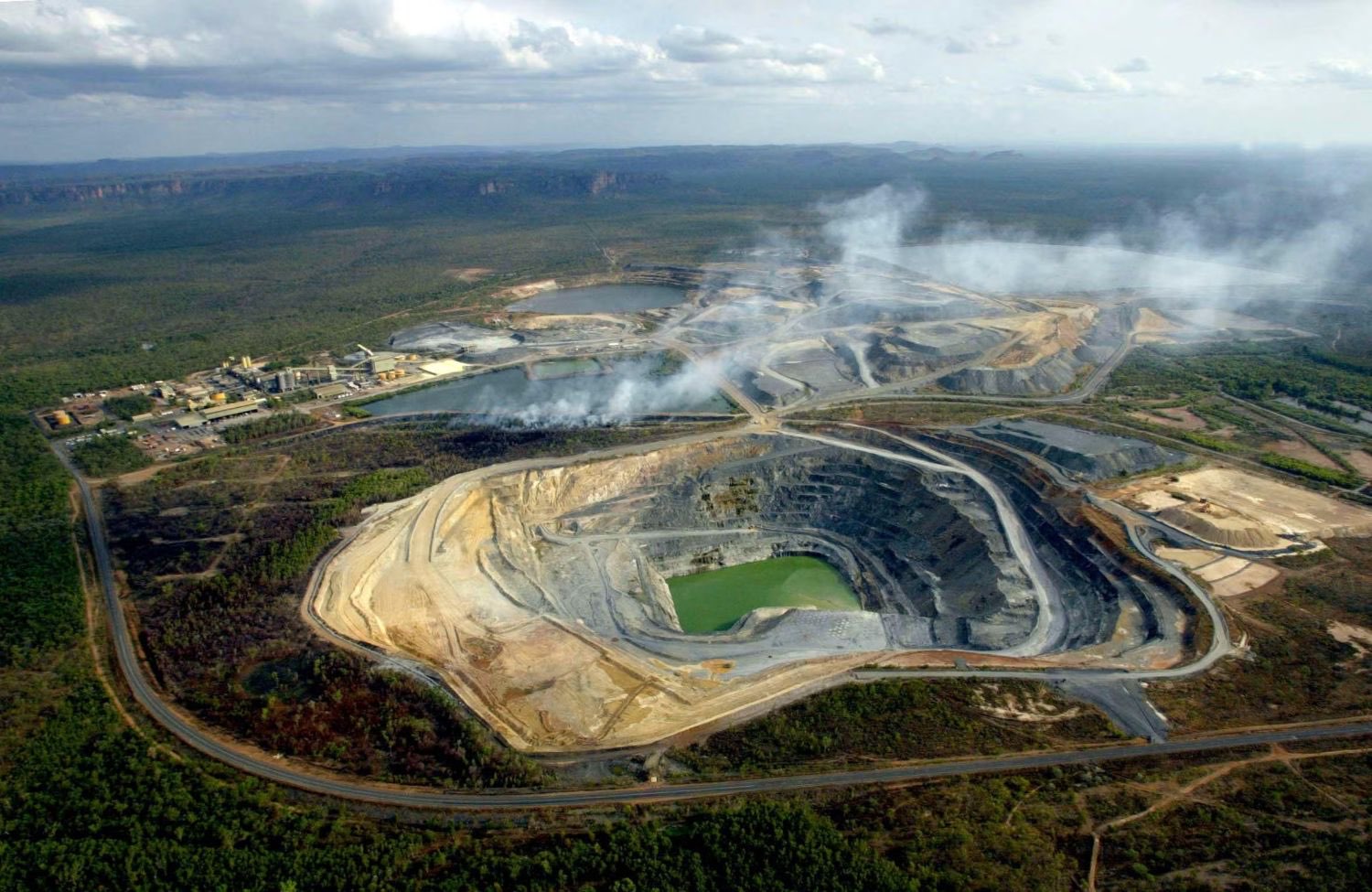
Uranium is the densest fuel on Earth — and the most politically supervised commodity in it. Mining is spread across five continents, but every kilogram of reactor fuel must pass through a handful of conversion and enrichment plants, nearly half of them Russian. This site tracks where uranium is mined, converted and enriched, and how AI power deals, a US–Russia decoupling and record fuel prices are redrawing the map — using open data from the WNA, IAEA, EIA and BGS.
0uranium mined worldwide, 2025 (est.) — ~90% of what reactors consumed
0of world mine supply from Kazakhstan, 2025
0of world enrichment capacity held by Russia's Rosatom
0per lb — Feb 2024 spot peak, a 16-year high
Interactive map
The uranium world map
Major producing mines, conversion, enrichment and fuel-fabrication plants, disrupted operations and development projects. Tap a marker for details; toggle layers below. Circle size ≈ scale of operation.
Uranium trades in a ladder of forms — from rock holding a gram of metal per kilogram to ceramic pellets that each match a tonne of coal. Every rung is a separate market with its own price, and the chokepoints sit between the rungs. Tap a stage.
From wellfields in the Kazakh steppe to a reactor core running for two years without refuelling, uranium passes through a chain where the geography narrows at every step — and where the last two steps are the most contested.
← swipe →
Production & resources
Where uranium comes from
Mine production by country, 2024
Tonnes of uranium, log scale (WNA; world total ~60,200 tU)
Source: World Nuclear Association, World Uranium Mining Production (updated Jan 2026). 2025 estimate ~62,200 tU, with Kazakhstan at 25,839 tU (~41%).
Known recoverable resources
Thousand tonnes of uranium (world total ~6,080 ktU)
Source: NEA/IAEA "Red Book" via WNA — identified recoverable resources to $130/kgU (2021 data). More becomes viable at higher prices.
World mine production, 1970–2024: the long cycle
Tonnes of uranium per year — the Cold War peak, the 1990s slump under weapons-stockpile downblending, Kazakhstan's ISR boom, the post-Fukushima trough, and the current recovery
Sources: BGS World Mineral Statistics (production, 1970–2024); WNA (2025 reactor requirements, 68,920 tU — dashed line). Mines covered ~90% of requirements in 2024; secondary supplies fill the rest.
Compare uranium production country by country since 1970 — and 110 other commodities — in the BGS data explorer.
Conversion & enrichment
The chokepoint is the centrifuge
Uranium mining spans five continents — no fuel can skip the midstream. Five plants convert yellowcake to gas, four companies enrich virtually all of it, and Russia's Rosatom alone holds about 43% of world enrichment capacity. With a US import ban going absolute in 2028, the West is building centrifuges faster than at any time since the Cold War.
Enrichment geography
A four-company industry racing to de-Russify before the 2028 cliff
🇷🇺The Rosatom fleet
Four enrichment complexes give Russia ~27.1M SWU a year — about 43% of world capacity — plus conversion at Seversk. Russia was still the single largest enrichment supplier to both US and EU reactors in 2025: 26% of US enrichment purchases and 22.6% of EU deliveries (EIA; Euratom Supply Agency).
⏳The 2028 cliff
The US ban on Russian enriched uranium (signed May 2024) allows waivers only until 1 January 2028. Russia counter-restricted exports to the US in November 2024. DOE has deferred decisions on 2026–27 waivers — utilities are contracting around a hard deadline with no slack.
🏗️The Western buildout
Urenco is expanding all four sites and broke ground on a 2.1M-SWU plant at Eunice, New Mexico in August 2026 (~+50% US capacity); Orano is extending Georges Besse II ~30% and planning a ~$5B plant at Oak Ridge; Centrus is building LEU centrifuges in Ohio; startup General Matter took over Paducah. DOE seeded it all with $2.7B in January 2026.
🧪The HALEU bottleneck
Most advanced and small modular reactors need high-assay LEU (5–20%) — a fuel only Russia's TENEX sold commercially until Centrus's Piketon plant delivered America's first kilograms in 2023, reaching 900 kg by January 2026. DOE has allocated ~21 t to eight developers; Urenco's Capenhurst HALEU line follows in the early 2030s.
Million separative work units (SWU) per year — the step where the market concentrates
Source: WNA (2025 nameplate capacity, ~62.9M SWU total vs ~50M SWU demand). CNNC's capacity is heading toward ~17M SWU by 2030.
From ore to fuel rod, step by step
Primary route (top); secondary supply and the HALEU branch (bottom). Scroll sideways on mobile →
Enrichment is measured in separative work units (SWU); a typical large reactor needs ~100–120 SWU-equivalents of fuel services per year. MOX = mixed uranium-plutonium oxide fuel from reprocessing.
Demand
The reactor renaissance
After a lost post-Fukushima decade, uranium demand is rising on every front at once: 441 operable reactors with 79 under construction, tech giants signing decade-long power deals, thirty-plus countries pledged to triple nuclear capacity — and the World Bank financing it again for the first time since 1959.
🖥️AI buys the atom
Microsoft's 20-year deal to restart Three Mile Island (Sept 2024) opened the floodgates: Meta–Constellation and Meta–Vistra, Amazon–X-energy and Amazon–Talen, Google–Kairos — over 9.8 GW of announced tech-nuclear capacity by 2026. Data centres turned nuclear's steady megawatts into a premium product.
🇨🇳China's fleet
64 reactors operable, 37 under construction — nearly half the world's new build — and 10+ approvals a year for four years running. China is on track for ~100 GWe around 2030, overtaking the US fleet, and is locking up uranium from Kazakhstan to Namibia to feed it.
🔄The restart wave
Japan's Kashiwazaki-Kariwa — the world's largest nuclear plant — returned to commercial operation in April 2026 after 14 years. Palisades in Michigan is poised to become the first-ever US restart of a shut-down reactor; Three Mile Island follows in 2027 with a $1B DOE loan. Spain just blinked first on its phase-out, extending Almaraz to 2030.
🧱SMRs break ground
TerraPower's Natrium began nuclear-island construction in April 2026 — the first NRC construction permit for a commercial advanced reactor — with Oklo, X-energy/Dow and NuScale's Romanian project close behind. Four US test reactors reached criticality by July 2026. Nearly all of them run on HALEU nobody yet makes at scale.
~150,000 tUthe World Nuclear Association's reference-case projection of annual reactor uranium requirements by 2040 — more than double 2025's 68,920 tU. The IAEA's 2025 high case sees nuclear capacity reaching 992 GWe by 2050, 2.6× today's fleet.
Geopolitics
From backwater to battleground
For a decade after Fukushima, uranium was the market nobody wanted. Between 2023 and 2026 a coup, a price spike, a US–Russia decoupling, a tech-money stampede and a $2.7 billion enrichment programme turned the nuclear fuel chain into contested strategic territory.
Jul 2023
The Niger coup
A military junta topples the government of the world's No. 7 producer, then supplying a quarter of the EU's natural uranium. Export routes close, Orano's Imouraren licence is withdrawn (June 2024), production at Somaïr halts (Oct 2024) — and ~4–5% of world mine supply begins sliding off the market.
Dec 2023
COP28: triple it
More than 20 countries pledge to triple world nuclear capacity by 2050 (31 signatories by COP29). Nine months later, 14 global banks — from Goldman Sachs to BNP Paribas — endorse the goal, reopening capital markets that had shunned nuclear for decades.
Feb 2024
$106 uranium
Kazatomprom warns sulfuric-acid shortages will hit production, and spot uranium spikes to ~$106/lb — the highest since 2007, nearly quadruple its level three years earlier. The signal is received: the fuel cycle has run out of slack.
May 2024
The US bans Russian uranium
The Prohibiting Russian Uranium Imports Act bans Russian enriched uranium from August 2024, with waivers permitted only until 1 January 2028 — and unlocks $2.7B for domestic enrichment. Russia counter-restricts exports to the US in November. Two fuel chains begin to separate.
Sep–Oct 2024
Big tech goes nuclear
Microsoft signs a 20-year PPA to restart Three Mile Island Unit 1 for its data centres. Within weeks: Google orders SMRs from Kairos, Amazon backs X-energy with plans for 5 GW. The most demand-starved market in commodities suddenly has the world's richest buyers.
Dec 2024
Orano loses Somaïr
The French state champion declares loss of operational control of its Niger mine; the junta runs it and blocks ~1,000 t of yellowcake from leaving. Rosatom, meanwhile, quietly starts selling its Kazakh mine stakes to Chinese buyers.
May 2025
Washington's 400-GW order
Four executive orders target a quadrupling of US nuclear capacity to 400 GW by 2050, ten large reactors under construction by 2030, 18-month licensing caps and a domestic enrichment surge. An earlier Section 232 probe puts uranium imports under national-security review.
Jun 2025
The dam breaks
In one month: the World Bank lifts its ban on financing nuclear power (in place since the 1950s), Meta signs 20 years of Clinton's output, Amazon expands at Susquehanna to 1.92 GW — and Niger formally nationalises Somaïr, sending Orano to arbitration.
Sep–Nov 2025
Critical mineral, finally
The WNA's Fuel Report projects requirements doubling to ~150,000 tU by 2040 and warns existing mines deplete from the mid-2030s. On 7 November, uranium — absent from the August draft — is added to the final 2025 US critical minerals list after a DOE push.
Jan 2026
The $2.7 billion month
DOE awards $900M each to Centrus (HALEU), General Matter (HALEU at Paducah) and Orano (LEU at Oak Ridge). Spot uranium breaks back above $100/lb; Japan restarts Kashiwazaki-Kariwa, the world's largest plant. A Section 232 proclamation finds uranium imports a security threat — but orders negotiations, not tariffs.
Feb–Jun 2026
The construction decade begins
Denison takes FID on Phoenix (Feb 24); NexGen's Arrow — the largest development-stage uranium project anywhere — wins final federal approval (Mar 5); TerraPower pours nuclear-island concrete (Apr); Urenco announces a 2.1M-SWU plant in New Mexico (Jun 2); Orano starts building Zuuvch-Ovoo in Mongolia (Jun).
Aug 2026
Records at the top of the chain
The long-term price prints $95.50/lb — an all-time high for the series — with spot climbing to ~$90 as Kazakh delays bite. Urenco breaks ground at Eunice with the US Energy Secretary in attendance; Energy Fuels lands a conditional $725M defense loan; Spain extends Almaraz. The rebuild is now visibly under way — and still years from delivering.
Sources: WNN/WNA; Congress.gov (H.R.1042); Federal Register (2025 critical minerals list); DOE; Orano, Kazatomprom, Cameco, Constellation and other company disclosures; Al Jazeera, Reuters, S&P Global, ANS Nuclear Newswire (2023–26).
Trade & prices
A two-price market — and a two-bloc one
Uranium has no exchange: it trades in bilateral contracts, with a thin spot market setting the headline price and long-term contracts moving the actual fuel. Since 2022 both have repriced violently — and the market has begun splitting into Western and Russia-China supply chains.
Spot vs long-term price, 2020–2025
$/lb U₃O₈ — the term price, where utilities actually buy, kept rising straight through the 2024–25 spot correction
Source: UxC/TradeTech indicators as published by Cameco (spot = annual average of month-ends; long-term = year-end; 2020–23 approximate). Aug 2026: spot ~$90/lb; long-term $95.50/lb — a record for the series.
US utility uranium purchases by origin, 2025
Share of 46.9 Mlb U₃O₈e bought by US reactor operators — domestic mines supplied just 7%
Source: EIA Uranium Marketing Annual 2025 (released Aug 2026). Weighted average price $58.46/lb; 87% of deliveries under long-term contracts.
How the market really works
What the 2024–26 repricing did to a contract-driven trade
Spot vs term
Only ~13% of US deliveries priced off spot in 2025. The long-term price climbed from $32/lb (2020) to $95.50/lb (Jul 2026) without a single down year — the clearest signal that utilities believe the shortage is structural.
The financial squeeze
The Sprott Physical Uranium Trust has hoovered up ~75 Mlb since 2021 (buying 8.67 Mlb in 2025 alone) and Yellow Cake holds another ~24 Mlb — together roughly 60% of a year's mine output, sequestered from the spot market indefinitely.
The contracting gap
Utilities term-contracted ~160 Mlb in 2023 — the first replacement-rate year in a decade — but only ~110–116 Mlb in 2024–25. UxC estimates ~60% of 2030 requirements are still uncovered, and ~3.1 billion lb through 2045.
The whole chain repriced
The scarcer steps moved most: enrichment hit a record ~$190/SWU spot (vs $56 three years earlier) and conversion rose ~230% in five years. Owning centrifuges, not pounds, was the trade of the decade.
Sources: Cameco-published UxC/TradeTech indicators; EIA UMAR 2025; Sprott/Yellow Cake disclosures; UxC via trade press (2025–26).
The steppe superpower: Kazakhstan
The world's biggest producer mines with acid, sells in two directions, and ships past Russia
Kazatomprom has led world supply since 2009 — every tonne from in-situ leaching, which needs vast amounts of sulfuric acid. Acid shortages forced repeated guidance cuts (2026: ~10%, to 27,500–29,000 tU), and its new acid plant has slipped to 2027–28. Ownership tells the geopolitical story: Cameco, Orano, Rosatom and Chinese state firms all hold stakes in Kazakh mines — but Rosatom is selling down to Chinese buyers, and the ramping Budenovskoye mine is committed to Russia through 2026. To reach Western customers without crossing Russia, 48% of 2025 deliveries went via the Trans-Caspian corridor — at five times the freight cost.
25,839 tUKazakhstan's 2025 production (Kazatomprom, 100% basis) — about 41% of world supply, more than the next three producers combined. Its 2026 guidance is explicitly "subject to sulphuric acid availability".
Uranium's concentration problem is double-jointed: one country dominates the ore, another dominates the step that turns it into fuel. And the buyer of last resort for new reactors — China — is building faster than everyone else combined.
43%
of the world's uranium enrichment capacity belongs to Russia's Rosatom (WNA, 2025). Concentration along the mine-to-reactor chain:
Sources: WNA (mine production 2025; enrichment capacity 2025; reactors under construction, Aug 2026); EIA Uranium Marketing Annual 2025 (US enrichment purchases). Conversion is similarly tight: five commercial plants worldwide.
Dual use
The most supervised substance on Earth
Uranium is the only commodity whose supply chain is defined by weapons treaties. Every gram of traded material is safeguarded, every enrichment plant is a proliferation question — and the military and civilian fuel cycles have always fed each other.
☮️Megatons to Megawatts
From 1993 to 2013, 500 tonnes of highly enriched uranium from ~20,000 dismantled Soviet warheads were downblended into reactor fuel — powering roughly 10% of US electricity for two decades. It was history's greatest swords-to-ploughshares programme, and it suppressed uranium mining for a generation.
🚢Naval propulsion
Submarines and aircraft carriers run on compact reactor cores — US and UK boats on weapons-grade HEU, French ones on LEU. The AUKUS submarine pact made naval fuel a live policy issue in three capitals, and naval demand sits permanently outside the civilian market.
🛡️The proliferation firewall
The same centrifuges that make 5% reactor fuel can make 90% weapons material — which is why enrichment technology is the most tightly guarded industrial secret on Earth, why IAEA safeguards track uranium by the gram, and why only a handful of countries are allowed to build capacity at all.
🔩Depleted uranium
Enrichment's leftover tails — over a million tonnes worldwide — serve as armour plate, penetrators and radiation shielding, and are now a resource: startup General Matter plans to re-enrich the DOE tails cylinders stored at Paducah into fresh reactor fuel.
⚗️Tritium & the defence fleet
US warhead tritium is made in a civilian TVA power reactor — but treaty rules require it to run on unobligated, US-origin enriched uranium. That obscure constraint is one of the quiet drivers of Washington's rush to rebuild domestic enrichment.
📦Strategic stockpiles
The US holds a modest strategic uranium reserve (established 2020) and large DOE legacy inventories; Russia keeps state reserves; China is widely assessed to be stockpiling well beyond reactor needs. Uranium joined the US critical minerals list in November 2025 — decades after it first became strategic.
Sources: DOE/NNSA public materials; Congressional Research Service; IAEA; WNA (Megatons to Megawatts, military warheads library pages); Federal Register (2025 critical minerals list).
Capital flows
Where the uranium money is going
A decade of underinvestment left the fuel cycle short at every step just as demand inflected. Capital is now arriving at all of them at once — presented as observation, not investment advice.
🏗️The new-mine bet
NexGen's Arrow — approved March 2026, capacity up to ~30 Mlb/yr — is the biggest single supply addition on any horizon; Denison's Phoenix took FID in February 2026; CNNC put $321M into Bannerman's Etango; Orano committed ~$1.6B to Mongolia's Zuuvch-Ovoo. Almost none of it delivers before 2028–30. In Namibia, Africa's largest producer, uranium is exempt from the 2023 ban on exporting unprocessed critical minerals, but several flagship mines sit in or beside the Namib-Naukluft National Park and mines must run on desalinated seawater.
🌀Enrichment is the new trade
The value moved downstream: DOE's $2.7B (Jan 2026) seeded Centrus, General Matter and Orano's US plants; Urenco is expanding on both sides of the Atlantic; Cameco's 49% of Westinghouse turned a miner into a fuel-cycle house. Conversion and SWU prices at records reward whoever owns the plumbing.
💰Financial uranium
SPUT (~75 Mlb) and Yellow Cake (~24 Mlb) turned physical pounds into a listed asset class and put a floor under spot — SPUT's 2025 buying nearly tripled year on year. Utilities now compete with funds for the same drums of yellowcake.
⚠️The risks
Demand is policy-shaped and can reverse; restart juniors stumbled repeatedly (Boss, Peninsula, Lotus all cut or withdrew guidance in 2025–26); Kazatomprom retains swing capacity if acid arrives; secondary supplies and SPUT flows can whipsaw spot; and reactors, not headlines, ultimately set the burn rate. Conservation is a live constraint too: Tanzania redrew the Selous (now Nyerere) World Heritage reserve in 2012 to make room for uranium mining.
This section describes where capital is flowing, based on public data. It is not financial advice.
Sources: company and government disclosures; DOE; UxC and WNA via trade press; Reuters, WNN, ANS (2025–26); OECD (2026) on Namibia and Tanzania.
Company tracker
The companies that move uranium
Miners, converters and enrichers, developers and the physical funds. Two producers — Kazatomprom and Cameco — mine over half the world's uranium; four companies enrich nearly all of it. Filter by segment or search.
Company
Segment
Key assets
Status & recent signals
Company status reflects public disclosures as of August 2026. This is an observational tracker, not investment advice.
Sources: company disclosures & filings; WNA; EIA; trade press (WNN, Reuters, ANS Nuclear Newswire, Northern Miner).
Supply disruptions & companies — disclosures from Kazatomprom, Cameco, Orano (Niger arbitrations), Paladin, Boss, Energy Fuels and others; WNN, ANS Nuclear Newswire, Reuters.
Notes — mine and plant coordinates are approximate. Enrichment and conversion shares are nameplate capacity, not output; where sources disagree (e.g. Uzbekistan's 2025 output), the more conservative figure is used. Production figures are tonnes of uranium metal (tU); 1 tU ≈ 2,600 lb U₃O₈. Last data refresh: August 2026.
FAQ
Common questions
Is the world running out of uranium?
No. Identified recoverable resources are around 6 million tonnes of uranium — roughly ninety years at current mining rates, with far more available at higher prices and in unconventional sources. The squeeze is about timing, not endowment: existing mines deplete significantly by the mid-2030s, a new mine takes ten to twenty years from discovery to production, and the World Nuclear Association projects reactor requirements will more than double to about 150,000 tonnes a year by 2040.
Which country produces the most uranium?
Kazakhstan mined about 25,800 of the world's roughly 62,000 tonnes of uranium in 2025 — around 41% — ahead of Canada (~13,400 t) and Namibia. But mining is only half the story: Russia controls about 43% of the world's enrichment capacity, the step every kilogram of reactor fuel must pass through.
Why is enrichment the chokepoint if uranium mining is spread across five continents?
Four companies — Rosatom, Urenco, CNNC and Orano — operate virtually all commercial enrichment capacity, and Rosatom alone holds about 43% of it. US utilities still bought 26% of their enrichment from Russia in 2025, even though a US import ban takes full effect in 2028 when waivers expire. That cliff triggered a $2.7 billion US enrichment programme and the largest Western capacity buildout in decades — but new centrifuge plants take years to come online.
What did the US ban on Russian uranium do?
The Prohibiting Russian Uranium Imports Act, signed in May 2024, banned Russian enriched uranium from August 2024 but allows waivers until 1 January 2028. Russia answered in November 2024 with its own restrictions on enriched-uranium exports to the US. The ban unlocked $2.7 billion for domestic enrichment, awarded in January 2026 to Centrus, General Matter, Orano and Global Laser Enrichment — yet Russian material still covered about a quarter of US enrichment purchases in 2025.
What is driving uranium demand?
A reactor fleet that is growing again: 441 operable reactors (~404 GWe) with 79 under construction, 37 of them in China. AI data-centre power deals — Microsoft's Three Mile Island restart contract, Meta-Constellation, Amazon-X-energy, Google-Kairos, together more than 9 GW — turned big tech into a nuclear buyer, more than thirty countries have pledged to triple nuclear capacity by 2050, and the World Bank lifted its decades-old ban on financing nuclear power in June 2025.
Why did uranium prices spike in 2024 — and where are they now?
Spot uranium hit about $106 per pound in early February 2024 — a sixteen-year high — after Kazatomprom warned that sulfuric-acid shortages would hit production, capping a run driven by supply cuts, the Sprott Physical Uranium Trust and post-2022 energy security fears. It fell back to $64 by March 2025, then recovered to about $90 by August 2026. The long-term contract price, where most uranium actually trades, kept climbing to a record $95.50 per pound — and enrichment and conversion prices set all-time records too.
Need a deep-dive report on uranium?
That's exactly what we do. We produce commissioned deep-dive reports on uranium, covering angles such as mine supply and the mid-2030s depletion question, enrichment and conversion chokepoints, exposure to Russian material ahead of the 2028 waiver cliff, demand from reactor buildouts, restarts and big-tech power deals, and how spot and long-term contract prices behave. Every report is source-cited — charts, maps and citations included — and built on the same open, verified data behind this dashboard. Email hello@mineral.watch with a short note on what you need and we'll come back with a scoped proposal.
Custom research
Need an ad hoc data-driven research report?
We produce bespoke, source-cited research on uranium and other strategic minerals — supply-chain mapping, trade-flow analysis, country and commodity deep-dives — built on the same open data behind this dashboard.
mineral.watch is an independent data hub, and it grows with the people who use it. Introduce yourself and we'll let you know when the uranium figures on this dashboard are updated and when new dashboards, datasets and research go live — no noise, just what's new.
Telling us your sector and organisation helps too: it shows us who relies on this data — analysts, policymakers, journalists, researchers — and shapes what we build next, from new minerals to custom research.
Prefer to talk directly? Corrections, data tips and collaboration ideas are always welcome at hello@mineral.watch.